AI Agent Integration with Oracle ERP: Enterprise Automation
Learn how integrating AI agents with Oracle ERP automates finance, supply chain, and procurement operations with enterprise-grade governance and security.
- AI Agent Integration
- Oracle ERP
- Finance Automation
- Supply Chain AI
- Procurement Automation

Integration of AI Agents with Oracle ERP provides large-scale enterprise automation across finance, supply chain, and procurement operations while maintaining strict governance and security compliance. By orchestrating autonomous agents directly over Oracle REST and SOAP APIs, enterprises streamline multi-step workflows without replacing legacy infrastructure or breaking established business logic.
Multi-unit corporations operating on Oracle Financials, Supply Chain Management (SCM), and Purchasing often face complex manual bottlenecks. High transaction volumes require continuous data verification across departments, leading to operational delays, audit friction, and increased labor overhead. Integrating specialized AI agents solves these challenges by taking over complex transactional routines while keeping human experts in the loop for approval exceptions.
Enterprise Architecture for AI Agent Integration with Oracle ERP
Integrating autonomous AI agents into an Oracle Cloud or E-Business Suite (EBS) environment requires a security-first API architecture. Modern AI agents interact through Oracle Integration Cloud (OIC) or direct REST/SOAP endpoints, executing validated transactions without bypassing standard business rules.
Enterprise architectures typically deploy an orchestration engine that acts between the AI agent layer and Oracle databases. This layer ensures all actions align with strict access policies and maintain full audit logging.
- Role-Based Access Control (RBAC): AI agents inherit granular permission models identical to user profiles, preventing unauthorized module access.
- Bi-directional API Communication: Agents read master data (such as vendor items and general ledger codes) and trigger downstream actions like invoice creation.
- Audit Logging: Every action, decision confidence score, and human approval step is recorded in an immutable audit trail for compliance verification.
By leveraging autonomous agentic AI workflows, organizations automate complex tasks while protecting core system stability and security policies.
Transforming Enterprise Finance: Reconciliation and Accounts Automation
Financial operations in enterprise environments depend on strict accuracy, clear documentation, and timely reconciliation. Manual processing of thousands of supplier invoices, bank statements, and intercompany adjustments leads to operational drag and delayed reporting.
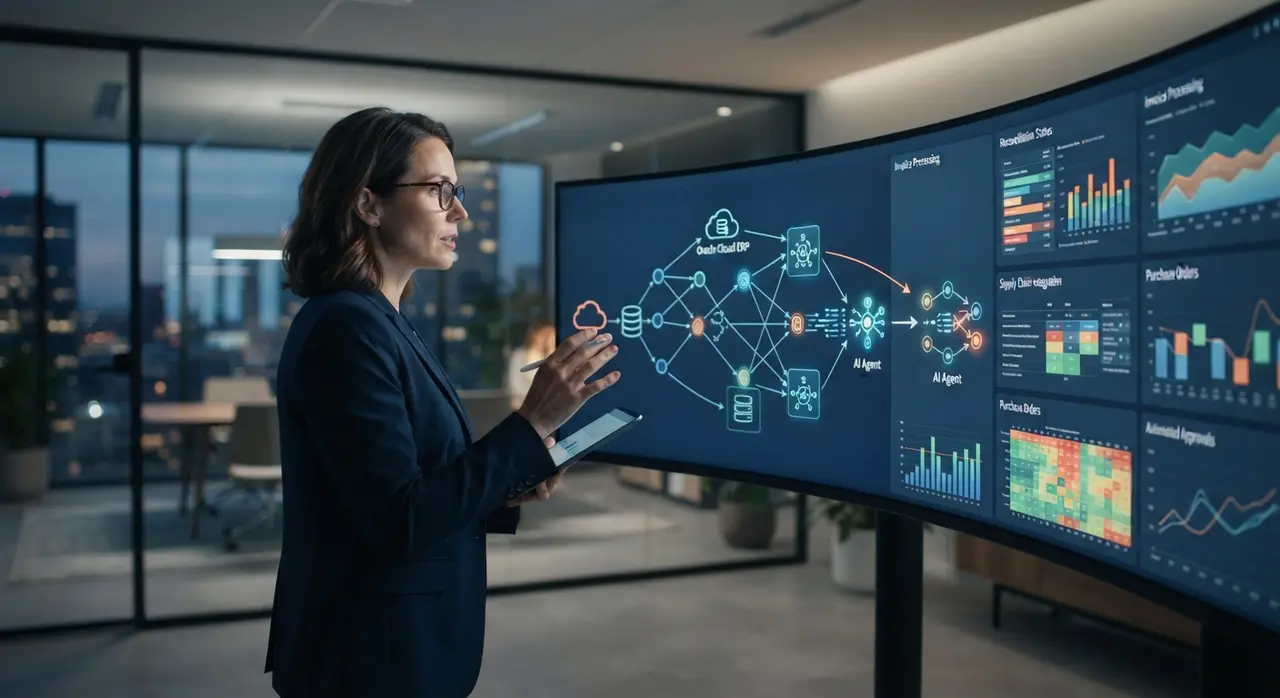
AI agents transform finance operations in Oracle ERP by continuously reading incoming structured and unstructured documents, matching them against system records, and identifying discrepancies.
Automated Three-Way Matching and Accounts Payable
In standard accounts payable workflows, agents pull supplier invoices from emails or portals, parse key fields using visual and textual models, and perform three-way matching against Oracle Purchase Orders (POs) and Receiving Documents. When numbers align within pre-set tolerances, the agent submits the voucher for payment approval. If discrepancies occur—such as tax mismatches or price variances—the agent routes the task to a human supervisor with highlighted line items.
Accelerating Financial Closing and Cash Flow Analysis
Month-end closing requires extensive bank reconciliations and intercompany balance verification. AI agents run automated background balance checks, flag un-reconciled items, and draft journal entries within Oracle GL. Furthermore, predictive AI models monitor customer payment history within Oracle Receivables to project bad debt risk and automate collection follow-ups before invoices become severely past due.
Supply Chain Optimization: Inventory Control and Demand Planning
Supply chain management across multiple warehouse locations requires real-time visibility and adaptive decision-making. Standard ERP systems store vast inventory and shipping data but rely heavily on manual human intervention to act on stock anomalies or demand shifts.
AI agents bridge the gap between static ERP records and real-world supply dynamics. By connecting Oracle SCM with external data sources—such as supplier lead times, port logistics updates, and regional sales signals—agents update safety stock levels dynamically.
- Automated Reorder Point Triggering: Agents monitor inventory thresholds in real time and initiate internal requisitions in Oracle SCM before stockouts occur.
- Supplier Lead-Time Monitoring: Agents track historical vendor delivery performance and update dynamic lead-time estimates across inventory modules.
- Disruption Handling: When transit delays occur, agents calculate alternative fulfillment paths and notify warehouse managers with proposed schedule revisions.
For multi-site industrial operations, incorporating supply chain AI for inventory and warehouse control significantly lowers carrying costs while protecting customer fulfillment metrics.
Large-Scale Procurement Automation: Vendor Management and Approvals
Large-scale procurement in enterprise organizations demands strict compliance with purchasing policies and vendor contracts. Manual processing of purchase requisitions, RFQs (Request for Quotes), and supplier performance reviews creates bottlenecked procurement queues.
AI agents execute non-strategic procurement tasks autonomously. When a purchase requisition is submitted in Oracle Procurement, an AI agent evaluates line-item specifications against existing contract terms, vendor price lists, and compliance certifications.
Streamlined RFQ and Vendor Selection
For items requiring fresh quotes, agents draft standardized RFQ templates, distribute them via vendor portals or email, and consolidate incoming supplier bids into comparison matrices within Oracle ERP. Human buyers review pre-evaluated comparisons rather than manually compiling spreadsheets.
Contract Lifecycle Management
AI agents actively monitor active supplier contracts in Oracle, tracking expiration dates, volume rebate thresholds, and SLA benchmarks. When renewal dates approach or volume commitments are met, agents draft notifications for procurement managers to maximize contract benefits.

Comparing Traditional Oracle Workflows with AI Agent Orchestration
Enterprise automation has evolved beyond basic script-driven routines and rigid macro tools. Comparing traditional Oracle processes with AI agent orchestration illustrates clear operational improvements.
| Operational Metric | Traditional Oracle Workflow | RPA Scripting | AI Agent Orchestration |
|---|---|---|---|
| Data Handling | Structured form inputs only | Pre-defined structured templates | Unstructured documents, PDFs, free text |
| Exception Handling | Requires manual human intervention | Stops execution upon error | Contextual reasoning + Human-in-the-loop routing |
| System Integration | Native ERP triggers & batch jobs | UI-level screen scraping | Native API & secure messaging integration |
| Adaptability | Static hardcoded business rules | Requires re-scripting on UI change | Dynamic reasoning over business constraints |
| Implementation Governance | Standard ERP user roles | Fragile credentials & UI bots | Enterprise RBAC + Immutable Audit Logs |
Governance, Security, and Compliance in Oracle Environments
Enterprise organizations adopting AI automation must satisfy rigorous compliance mandates, including Sarbanes-Oxley (SOX), GDPR, and internal audit requirements. Deploying AI agents requires clear boundaries regarding data access, system execution, and supervisory intervention.
Integrating agents via enterprise AI agent solutions ensures compliance standards are met through strict operational guardrails:
- Least Privilege Execution: Agents operate under distinct service accounts constrained to specific API permissions.
- Human-in-the-Loop Thresholds: High-value transactions (such as payments above set financial caps or contract approvals) automatically trigger mandatory human authorization.
- Transparent Reasoning Logs: Every decision made by an agent includes a step-by-step trace explaining the data evaluated, rules applied, and confidence scores calculated.
Enterprise Application: Manufacturing & Multi-Unit Distribution
A multi-unit regional manufacturer operating with Oracle ERP faced significant administrative delays across accounts payable and supplier order confirmation. Processing over 15,000 monthly invoices across eight plants resulted in continuous data entry backlogs and late payment fees.
By partnering with Agentes Autômomos, the company implemented an integrated AI agent layer over their Oracle ERP environment. The agents extracted invoice data from unstructured supplier PDFs, verified purchase order line items via native REST APIs, and matched batch receiving records.
As a result, invoice processing time dropped by over 70%, invoice exception resolution times dropped from days to minutes, and full SOX compliance was maintained without modifying their core Oracle infrastructure.
Conclusion
Integrating AI agents with Oracle ERP bridges the gap between complex enterprise data systems and real-time operational execution. By automating routine financial reconciliations, dynamic supply chain triggers, and procurement evaluation workflows, enterprises reduce processing cycles while improving audit consistency.
Rather than replacing legacy infrastructure or undertaking costly ERP migrations, organizations can layer autonomous AI workflows directly onto existing Oracle REST/SOAP services. Reviewing enterprise requirements with specialized automation partners ensures high operational returns with absolute compliance oversight.
Frequently asked questions
How do AI agents connect securely to Oracle ERP without breaking compliance?
AI agents connect via native Oracle REST APIs, Oracle Integration Cloud (OIC), or secure web services utilizing Role-Based Access Control (RBAC). Every transaction executed by an AI agent is logged into enterprise audit trails, ensuring complete compliance with SOX and internal corporate controls.
What happens when an AI agent encounters an exception or unfamiliar document format?
When confidence thresholds fall below pre-defined business rules, the AI agent flags the exception and routes the task to a human manager. The human supervisor receives a highlighted summary of the transaction, approves or corrects the decision, and the agent completes the workflow in Oracle ERP.
Do we need to replace our current custom Oracle setup or upgrade our database?
No, AI agents operate over standard API layers and interface services compatible with both Oracle Cloud ERP and on-premise E-Business Suite (EBS) environments. You maintain your current infrastructure, custom workflows, and database schema while enabling autonomous agent interactions.
How quickly can an enterprise deploy AI agents on top of Oracle ERP?
Initial production deployments typically take between 4 to 8 weeks depending on the process complexity and integration scope. Because agents use existing APIs rather than custom code rewrites, deployment cycles are significantly faster than traditional software implementations.