Multi-AI Agent Orchestration for Enterprises
Discover how multi-AI agent orchestration enables enterprise systems to coordinate complex business tasks, integrate ERPs, and enforce human oversight.
- Multi-Agent Systems
- Enterprise AI
- Process Automation
- AI Governance
- Workflow Orchestration
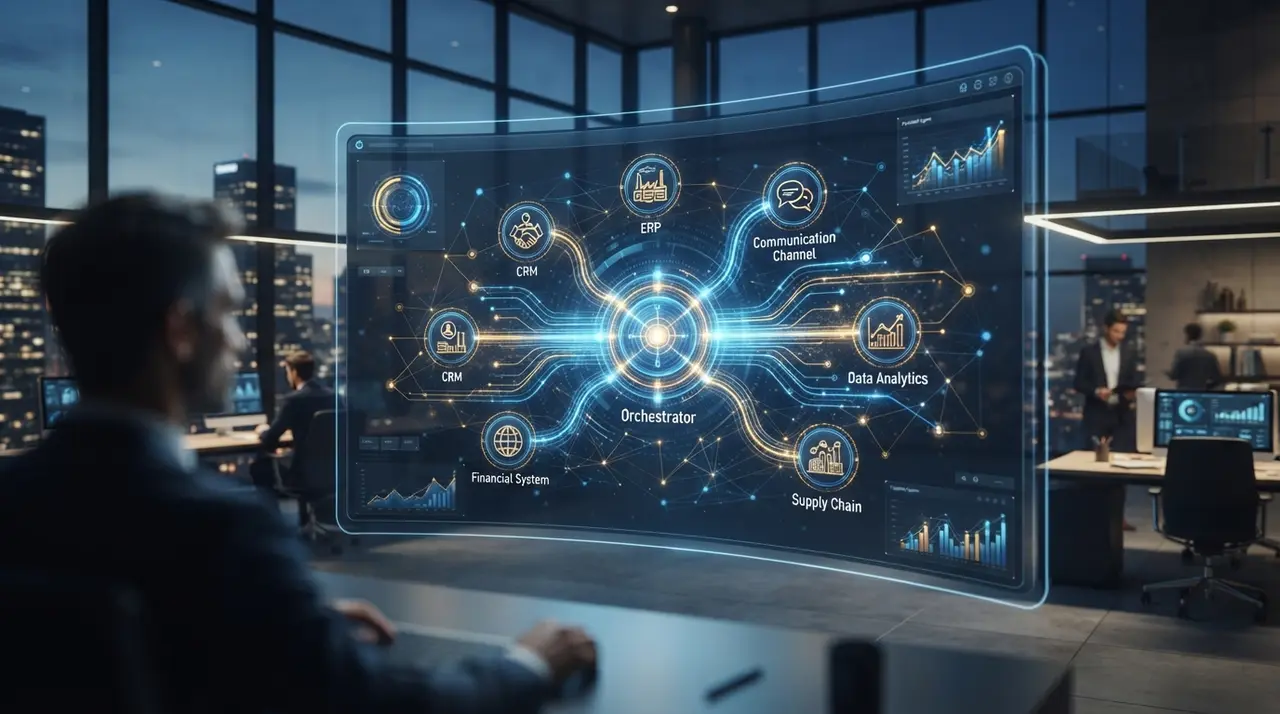
Multi-AI agent orchestration is the architectural framework that enables enterprise systems to coordinate complex tasks by breaking down large business goals into subtasks managed by specialized artificial intelligence units. Through centralized or distributed coordination, enterprise systems coordinate complex tasks across legacy software, CRMs, ERPs, and communication channels without requiring a complete overhaul of existing technology stack infrastructure.
As organizations scale their automation initiatives from simple chatbots to full-process execution, single AI models quickly hit execution limits. Enterprise operations—such as multi-unit inventory reconciliation, customer onboarding, or vendor invoice processing—require distinct skill sets, rigorous policy compliance, and predictable outcomes. Multi-AI agent orchestration bridges this gap by mimicking structured human operational teams.
Why Single AI Agents Fail at Complex Enterprise Workflows
Single AI models lack the contextual focus and specialized tooling required to reliably execute multi-step operational processes across enterprise systems. When a single model attempts to handle initial intake, rule validation, database lookups, decision logic, and external communications simultaneously, context windows become overloaded, leading to hallucinations, missed business rules, and degraded reliability.
Enterprise workflows rely on distinct domain expertise and specialized access rights. A financial approval process, for example, requires strict validation against corporate procurement policies, dynamic inventory checks, and integration with legacy ERP systems. For a deeper breakdown of how autonomous units compare to traditional generative models, read our analysis on agentic AI architecture.
- Context Distraction: Processing massive unstructured documents alongside execution scripts reduces reasoning accuracy.
- Security and Access Control: Granting a single agent full write permissions across all enterprise databases creates massive compliance risks.
- Lack of Modularity: Updating a single business rule requires retraining or re-prompting an entire monolithic system.
- Brittle Error Handling: If one step fails in a single-agent script, the entire business execution halts without granular recovery points.
Core Architectural Patterns for Orchestrating Enterprise Agents
Modern enterprise multi-agent systems rely on three primary structural patterns to coordinate distributed business operations efficiently. Choosing the right pattern depends on whether your process is linear, hierarchical, or dynamic.
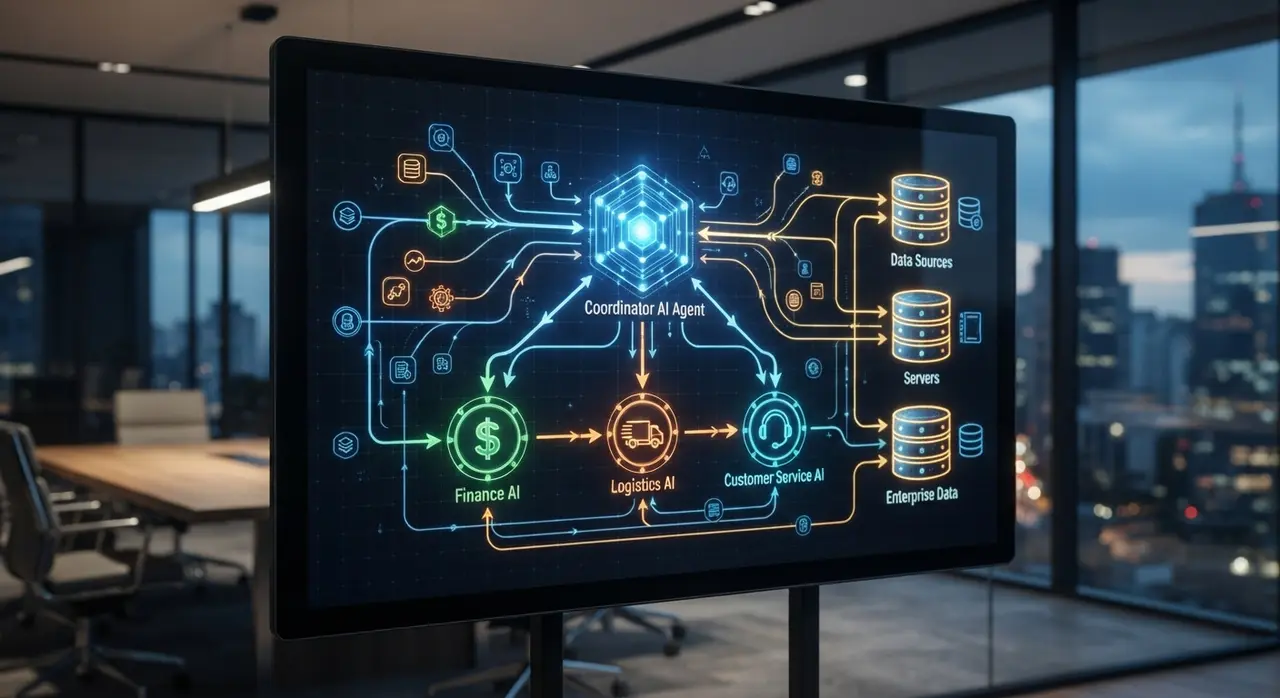
Understanding these patterns helps operational leaders choose the leanest architecture that delivers maximum reliability while reducing needless API overhead.
| Orchestration Pattern | Coordination Mechanism | Best Use Case | Primary Advantage |
|---|---|---|---|
| Pipeline (Sequential) | Linear execution chain where output of Agent A becomes input for Agent B. | Data extraction, document ingestion, basic lead triage. | Predictable execution flow and simple debugging. |
| Hierarchical (Manager-Worker) | Central Orchestrator delegates subtasks, evaluates outputs, and manages execution. | Complex customer support, vendor negotiations, procurement validation. | Strict governance, dynamic task breakdown, and centralized monitoring. |
| Collaborative (Peer-to-Peer) | Autonomous agents negotiate and exchange data directly based on dynamic protocols. | Supply chain rerouting, complex scheduling across departments. | High adaptivity in changing real-time environments. |
1. Pipeline (Sequential) Architecture
In a pipeline model, execution flows linearly from one specialized agent to another. For example, a Document Parsing Agent extracts text from an incoming purchase order, passes structured JSON to a Validation Agent to cross-reference stock in an ERP system, which then passes verified payload data to an Execution Agent to generate an invoice.
2. Hierarchical (Manager-Worker) Architecture
Hierarchical orchestration uses a master Orchestrator Agent acting as an operational team lead. The Orchestrator receives the macro-level objective from a human user or trigger event, evaluates the required steps, assigns sub-tasks to specialized domain agents, inspects their returned outputs for quality control, and consolidates the final result.
3. Collaborative (Peer-to-Peer) Architecture
Collaborative networks allow specialized agents to interact dynamically. When an anomaly occurs—such as a sudden stock shortage in a regional distribution center—a Logistics Agent can directly query an Inventory Agent and a Supplier Management Agent to evaluate alternative sourcing options before presenting an optimized recommendation to management.
Managing Shared State, Prevailing Loops, and Handling Failures
Robust enterprise orchestration requires strict protocol controls to handle state updates, recursive loop prevention, and graceful error recovery. Multi-agent coordination fails when agents pass unvalidated assumptions or enter endless conversational feedback loops.
To prevent operational breakdowns across critical business infrastructure, enterprise systems incorporate key technical safeguards:
- Centralized Memory & Shared State: State is maintained in a transactional database or key-value store rather than relying on agent conversation histories. This ensures a single source of truth across all processing units.
- Max-Iteration Caps & Timeouts: Every agent interaction has strict operational constraints. If a sub-task isn't resolved within three attempts, the system automatically triggers an escalation path.
- Fallback and Retry Strategies: When an API integration with an ERP times out, the Orchestrator pauses dependent sub-tasks, logs the temporary bottleneck, and retries using exponential backoff without crashing the entire workflow.
- Human-in-the-Loop Escalation: High-risk actions—such as financial transactions exceeding approval thresholds—are flagged and automatically routed to human managers via WhatsApp, email, or internal portals for one-click approval.
Real-World Operational Case: Automated Multi-Unit Customer Support
Multi-agent orchestration transforms high-volume customer inquiries across multi-unit operations into automated, policy-compliant resolutions. Consider how a regional retail chain streamlined customer claims using orchestrated agents.
A leading retail enterprise faced heavy support volume across 40 physical locations regarding order status, returns, and invoice corrections. By deploying an orchestrated solution built alongside Agentes Autônomos, the organization coordinated specialized agents directly over WhatsApp and their existing enterprise infrastructure:
- Triage Agent: Receives customer messages on WhatsApp, identifies intent (e.g., return request), authenticates the user, and collects invoice numbers.
- ERP Lookup Agent: Connects to legacy retail software to pull purchase records, store location details, and warranty status.
- Policy Validation Agent: Checks return conditions against company policies, determining whether the item qualifies for instant credit or requires physical inspection.
- Action & Notification Agent: Issues the return authorization code, updates stock status, and dispatches direct updates back to the customer on WhatsApp.
This multi-agent workflow eliminated manual data entry, slashed customer wait times from hours to under two minutes, and maintained 100% compliance with business rules without requiring staff to manually check multiple software portals. Explore similar deployments in our collection of real-world process automation examples.
Observability, Governance, and Human Oversight in Multi-Agent Systems
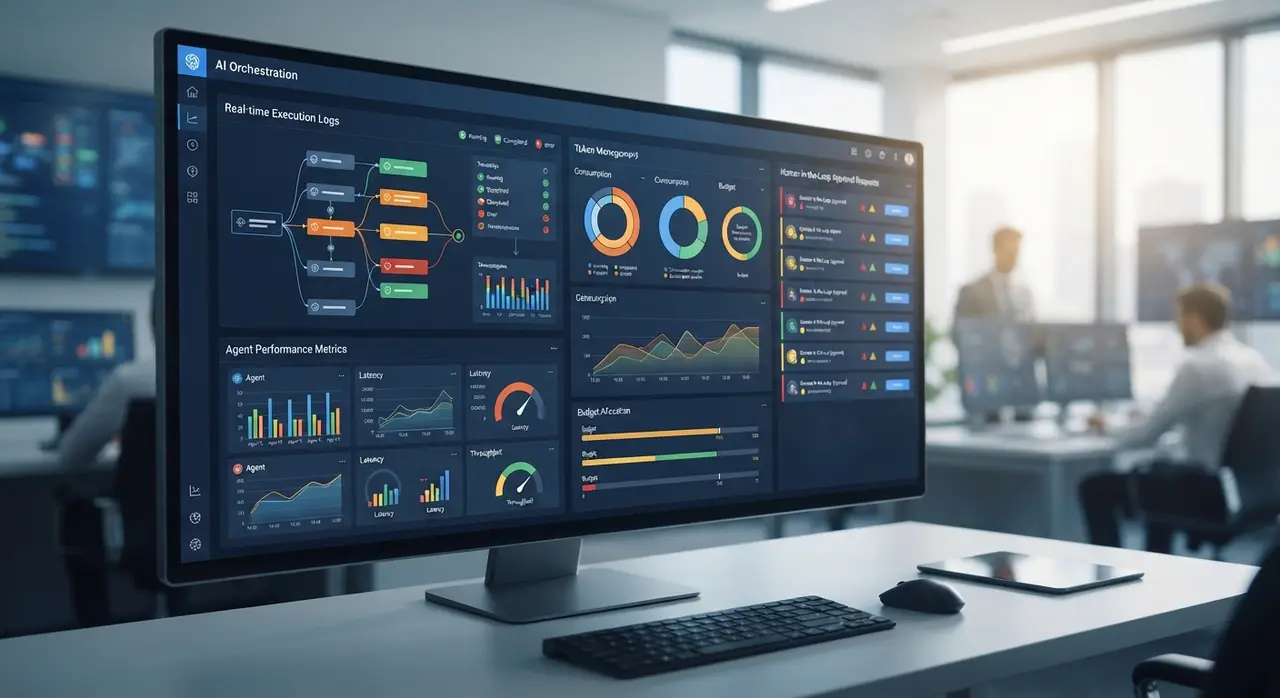
Maintaining operational control over autonomous agents requires end-to-end observability dashboards, clear audit logs, and granular human governance mechanisms. Enterprise leaders must know exactly why an automated system executed a decision at any point in time.
Enterprise governance for multi-agent deployment rests on three critical pillars:
- Execution Traceability: Every subtask breakdown, internal agent conversation, prompt input, and output vector must be recorded in secure audit logs for compliance reviews.
- Granular Role-Based Access Controls (RBAC): Individual agents operate under strict operational boundaries. A messaging agent cannot modify financial ledger records; only dedicated execution agents with explicit tokens can interact with sensitive API endpoints.
- Configurable Approval Thresholds: Operations managers define business logic rules where agent autonomy ends and human governance begins, preserving quality control while scaling volume.
By reviewing targeted enterprise AI agent solutions, business leaders can implement robust orchestration patterns tailored specifically to their governance requirements, infrastructure constraints, and operational KPIs.
Frequently asked questions
What is multi-AI agent orchestration?
Multi-AI agent orchestration is an architectural framework that coordinates multiple specialized AI agents to execute complex, multi-step enterprise tasks. An orchestrator breaks down overarching business goals, assigns subtasks to specialized agents, manages dependencies, integrates enterprise systems, and consolidates final outputs.
Why use multiple specialized agents instead of a single powerful AI model?
A single AI model often experiences context overload, hallucinations, and security compliance risks when forced to handle multi-step processes across legacy systems. Multiple specialized agents focus on specific domain sub-tasks—such as data extraction, policy validation, or API execution—resulting in higher accuracy, modular governance, and reliable enterprise operations.
How do multi-agent systems prevent infinite loops and execution failures?
Multi-agent frameworks enforce governance controls including maximum iteration caps, strict timeouts, shared state databases, and fallback mechanisms. If an agent fails to resolve a step or encounters an anomaly, the orchestrator triggers automated retry paths or escalates the task directly to a human decision-maker.
Do enterprise multi-agent systems require replacing our current software stack?
No, multi-agent orchestration frameworks connect directly to your existing IT infrastructure using APIs, database connectors, and messaging channels like WhatsApp, CRM systems, and legacy ERPs. They act as an operational orchestration layer above your software without requiring expensive system migrations.