Model Context Protocol MCP: Connect AI to Enterprise Systems
Learn how Model Context Protocol MCP connects AI agents to ERPs, CRMs, and databases without fragile custom code. Standardize enterprise AI context.
- Model Context Protocol MCP
- AI Integration
- Enterprise AI
- Process Automation
- AI Governance
Understanding Model Context Protocol MCP in Enterprise Automation
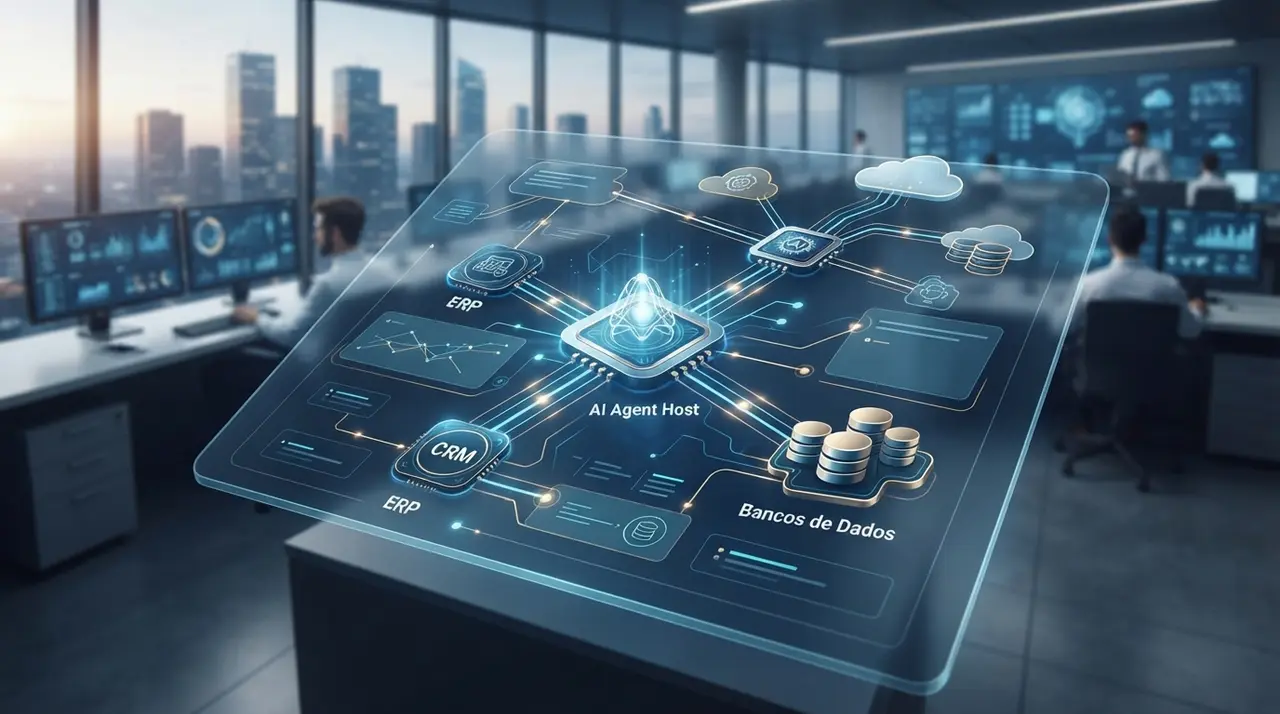
The Model Context Protocol MCP is an open standard that enables AI agents to securely connect with enterprise ERPs, CRMs, and databases through a unified architecture. By replacing custom point-to-point integrations with standardized server-client protocols, MCP reduces implementation fragility and maintenance overhead for operational teams.
As organizations scale AI adoption across customer support, sales, procurement, and finance, connecting Large Language Models (LLMs) to internal business systems becomes the primary bottleneck. Traditional custom integrations require dedicated engineering effort for every tool, endpoint, and database query. Model Context Protocol MCP solves this bottleneck by providing a universal adapter pattern for enterprise AI context.
The Problem with Custom Point-to-Point AI Integrations
Legacy integration methods force enterprise development teams to write tailored wrappers for every API, ERP module, and database. This creates a brittle architectural web where a single schema change in your CRM or ERP can break multiple downstream AI agent tasks.
When companies attempt to scale autonomous workflows using basic custom scripts or standalone function calling capabilities, technical debt rapidly accumulates. Maintenance costs rise as developers continuously re-engineer prompt templates, handle distinct payload formats, and manage fragmented authentication methods across different operational tools.
- High Maintenance Overhead: Every core system update requires re-coding custom AI connectors and endpoints.
- Fragile Context Delivery: Agents lose operational context when switching between separate database queries and API actions.
- Governance Bottlenecks: Auditing access permissions, data boundaries, and operational risks across hundreds of custom scripts is nearly impossible.
How Model Context Protocol MCP Standardizes AI Architecture
Model Context Protocol MCP standardizes context exchange by separating the client host from the data provider server through a standardized client-server protocol. This modular architecture allows AI applications to dynamically discover, read, and execute operations across external systems without hardcoding custom logic into the model itself.
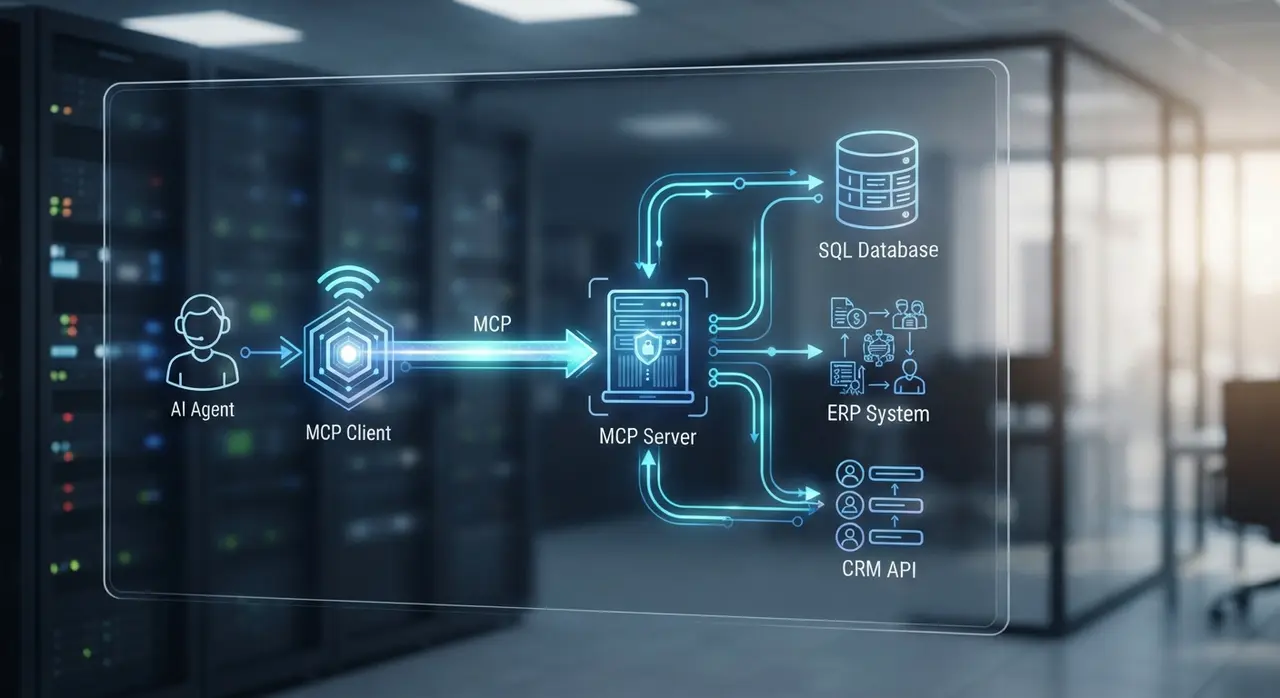
The MCP architecture relies on three primary building blocks that structure how AI models interact with your technology stack:
- MCP Clients: The AI applications, agent platforms, or IDEs that request context and command operational execution on behalf of the user.
- MCP Servers: Specialized lightweight programs that expose specific data sources (SQL databases, file systems) or actionable services (Salesforce, SAP, WhatsApp) via standard MCP primitives.
- Standardized Primitives: Unified abstractions covering Resources (file/data reading), Tools (executing functional actions), and Prompts (reusable contextual templates).
Comparing Integration Approaches for Enterprise AI
Understanding where MCP fits compared to traditional REST APIs and basic Function Calling is crucial for IT decision-makers evaluating long-term operational infrastructure.
| Feature / Dimension | Custom API Scripts | Native Function Calling | Model Context Protocol MCP |
|---|---|---|---|
| Setup Architecture | Tightly coupled custom code | Hardcoded model JSON schemas | Decoupled client-server standard |
| Reusability | Low (single-use pipelines) | Moderate (bound to vendor format) | High (universal connector ecosystem) |
| Security & Scope | Hardcoded tokens in scripts | Dependent on gateway wrapper | Granular server-level boundaries |
| System Discovery | Manual coding required | Static prompt definitions | Dynamic capability discovery |
| Maintenance Cost | High (breaks on schema shift) | Moderate (vendor spec changes) | Low (isolated server updates) |
Connecting MCP Servers to ERPs, CRMs, and Databases
Deploying Model Context Protocol MCP allows enterprise teams to expose legacy SQL databases, PostgreSQL instances, CRM platforms, and ERP suites through secure, pre-built, or lightweight custom servers. The AI agent queries the MCP server, which translates human intent into structured database queries or system actions safely.
For example, instead of allowing an AI model to run unrestricted database scripts, an MCP database server exposes strictly defined resource paths and operational tools. This architecture prevents unvalidated query execution while giving the AI full contextual awareness of customer status, order inventory, or financial ledgers.
Furthermore, MCP supports advanced context persistence and memory management across multi-step business workflows. The AI agent retains historical operational context across sessions, making complex multi-unit approvals and back-office reconciliations seamless.
Enterprise Security, Compliance, and Data Governance
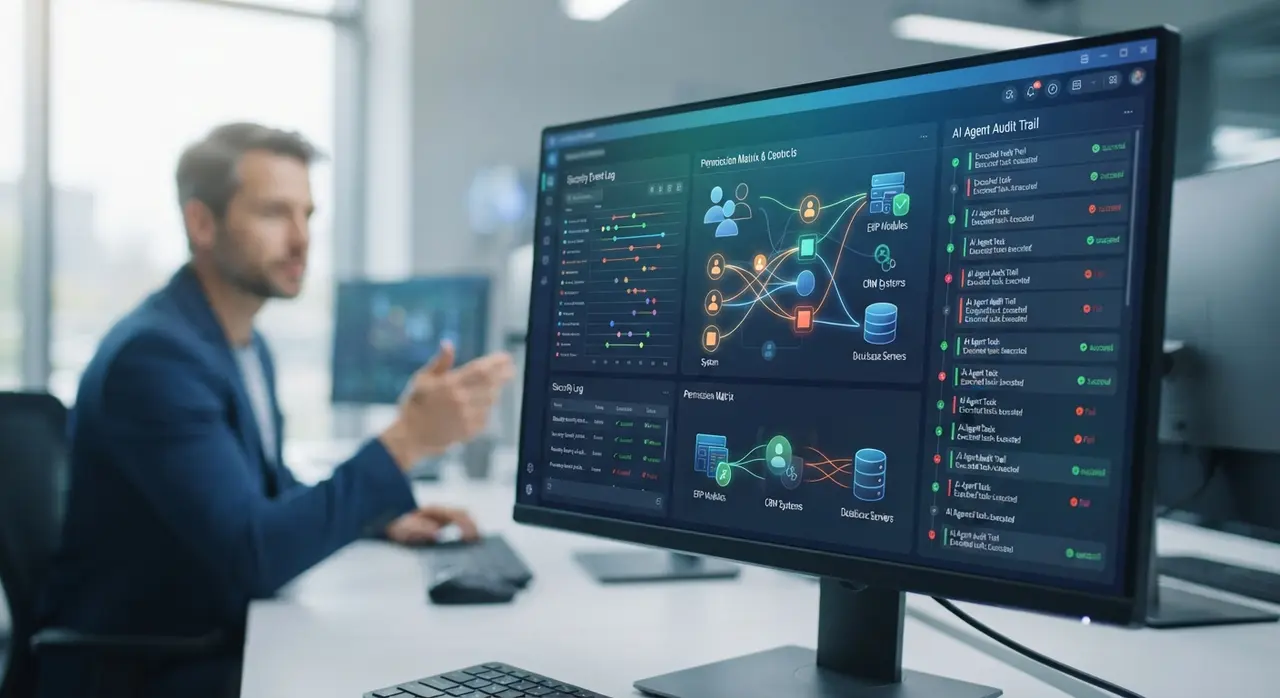
Model Context Protocol MCP enhances security by insulating core enterprise infrastructure behind controlled server boundaries. Because the MCP server controls what resources and tools are exposed, business operations leaders maintain total oversight of what data the AI model can read or alter.
Key governance benefits for operational and IT directors include:
- Granular Resource Scoping: Enterprise administrators restrict AI models to specific database tables, read-only schemas, or restricted API methods.
- Human-in-the-Loop Safeguards: High-risk operations (such as approving financial payouts or modifying ERP purchase orders) can require explicit human sign-off before the MCP tool executes.
- Centralized Audit Logging: Every request, query parameter, and tool invocation passing through an MCP server is logged for compliance audits.
Mini Case Study: Scaling Multi-Unit Supply Chain Operations
A regional distributor operating eight logistics hubs faced persistent operational delays caused by manual inventory reconciliation between their legacy ERP system, custom SQL warehouse database, and frontline WhatsApp communication channels.
To fix this bottleneck without replacing their legacy systems, the company partnered with Agentes Autônomos to deploy autonomous AI agents backed by standardized MCP infrastructure. Custom MCP servers were set up around their legacy database and ERP endpoints, allowing AI agents to perform immediate inventory availability checks, draft automated order requisitions, and update customer CRMs in real time.
By implementing this standardized framework, the organization achieved high-impact operational improvements:
- 85% Reduction in Manual Data Entry: Frontline warehouse managers stopped manually copying stock numbers between ERP modules and WhatsApp groups.
- Zero Infrastructure Upgrades: The existing legacy database and enterprise software remained completely intact.
- Rapid Deployment Time: Full operational rollout across all eight logistics hubs was completed in under four weeks.
How Agentes Autônomos Drives Enterprise Automation with MCP Standards
At Agentes Autônomos, we assist enterprise operational leaders in designing, building, and maintaining production-grade AI agents without taking unnecessary technical or commercial risks. We begin by conducting an in-depth AI automation diagnosis to identify high-ROI operational bottlenecks in sales, customer support, logistics, and back-office management.
By leveraging modern standards like Model Context Protocol MCP, we ensure that every AI agent integration is scalable, secure, and vendor-agnostic. Your business keeps its existing software stack while unlocking measurable productivity gains, reduced rework, and clear operational governance.
Frequently asked questions
What is Model Context Protocol MCP?
Model Context Protocol MCP is an open-standard architecture created to simplify how AI models securely access external context, enterprise databases, software tools, and APIs. It uses a client-server framework to replace brittle, custom-coded integrations with standardized connectors.
How does MCP differ from traditional REST API integrations?
Traditional REST API integrations require custom code, manual context passing, and specific endpoint wrappers for every AI interaction. MCP standardizes context discovery, tool invocation, and data fetching into a single unified protocol, dramatically reducing long-term maintenance costs.
Can MCP work with legacy ERP and database systems?
Yes, MCP is designed to bridge modern AI agents with legacy infrastructure. By wrapping legacy SQL databases, file servers, or ERP endpoints inside lightweight MCP servers, AI agents can interact with existing software without requiring infrastructure replacements.
Is data exposed through MCP secure and compliant?
MCP provides robust security advantages by enforcing strict authorization boundaries at the MCP server level. Enterprise administrators control which resources are exposed, enforce read-only permissions, and integrate human-in-the-loop approvals for sensitive operational actions.