
Function Calling: How AI Agents Execute Enterprise Tasks
Discover how function calling empowers AI agents to execute structured tasks across ERPs, CRMs, and corporate databases with zero security risk.
- Function Calling
- AI Agents
- ERP Integration
- Enterprise AI
- Process Automation

Understanding Native Function Calling vs. Orchestration Frameworks
Function calling is the technical mechanism that allows large language models (LLMs) to transform unstructured human requests into precise, structured API calls that trigger actions in enterprise software. By utilizing structured JSON schemas, AI agents execute real-time operations across ERPs, CRMs, and corporate databases without requiring custom hardcoded integrations for every user prompt.
Traditional chatbots operate in a text-in, text-out vacuum that limits them to retrieving static knowledge base articles. When a company needs an AI to verify real-time inventory balances, update customer addresses, issue invoices, or open support tickets, text generation alone fails. This is where Function Calling bridges the gap between natural language understanding and back-end execution.
Native function calling refers to capabilities built directly into foundation models by providers like OpenAI, Anthropic, or Google. The model is trained not to answer with conversational prose when a specific tool is required, but rather to output a structured JSON object containing the exact parameters needed to invoke an external function. In contrast, framework orchestration (such as LangChain or AutoGen) provides the surrounding logic that intercepts this JSON, executes the actual HTTP request against the destination system, and returns the endpoint's response back to the model.
How LLMs Convert Intent into Structured JSON Schemas
Large language models recognize user intent by matching incoming text against a registry of pre-defined tool definitions provided during the API request. Each tool definition contains a function name, an explicit description of what the function does, and an OpenAPI-compliant JSON schema defining required and optional parameters.
When a manager types: "Check inventory for product SKU-994 in the Chicago warehouse and update the reorder flag if stock is under 50 units," the model performs a series of logical parameter extractions:
- Intent Detection: Identifies two distinct action requirements: checking stock levels and conditionally updating a record.
- Function Selection: Selects
check_warehouse_stockandupdate_reorder_statusfrom its available tool catalog. - Parameter Extraction: Maps "SKU-994" to
sku_id, "Chicago" tolocation_code, and "50" tothreshold. - Schema Generation: Outputs a syntactically valid JSON object adhering precisely to the pre-configured parameters.

The host system receives this JSON structure, executes the SQL query or API request against corporate databases, and feeds the numerical outcome back into the model. The model then formats a human-friendly response or triggers the second function in the sequence.
Defining Secure Function Specifications for ERP and CRM Actions
Exposing backend capabilities to autonomous systems requires granular parameter definitions to prevent unexpected operational behavior. Developers specify available tools using standard JSON Schema syntax, ensuring strict data types for integer, string, boolean, and enum values.
Consider a sales operations agent tasked with creating new client entries inside Salesforce or HubSpot. The function specification explicitly enforces validation constraints directly at the schema level before any network request occurs:
{
  "name": "create_crm_account",
  "description": "Creates a new business account in the corporate CRM.",
  "parameters": {
    "type": "object",
    "properties": {
      "company_name": {
        "type": "string",
        "description": "Legal business name of the corporate client"
      },
      "tax_id": {
        "type": "string",
        "pattern": "^[0-9]{9}$",
        "description": "9-digit corporate tax identification number"
      },
      "credit_limit": {
        "type": "number",
        "maximum": 50000,
        "description": "Approved initial credit limit in USD"
      }
    },
    "required": ["company_name", "tax_id"]
  }
}
By defining explicit constraints such as regular expressions for tax IDs or maximum numeric caps on financial limits, the system blocks malformed or unsafe requests before they ever hit production database servers. To implement these workflows cleanly without replacing existing core systems, explore our tailored autonomous agent solutions built for corporate operations.
Enterprise Security Controls: Authentication, Rate Limiting, and Audit Trails
Exposing sensitive database endpoints to autonomous software agents introduces operational attack vectors that require enterprise-grade security protocols. AI agents must never connect to corporate systems with root database administrative privileges or unmonitored API keys.
To maintain absolute governance, operational teams must implement four core security layers:
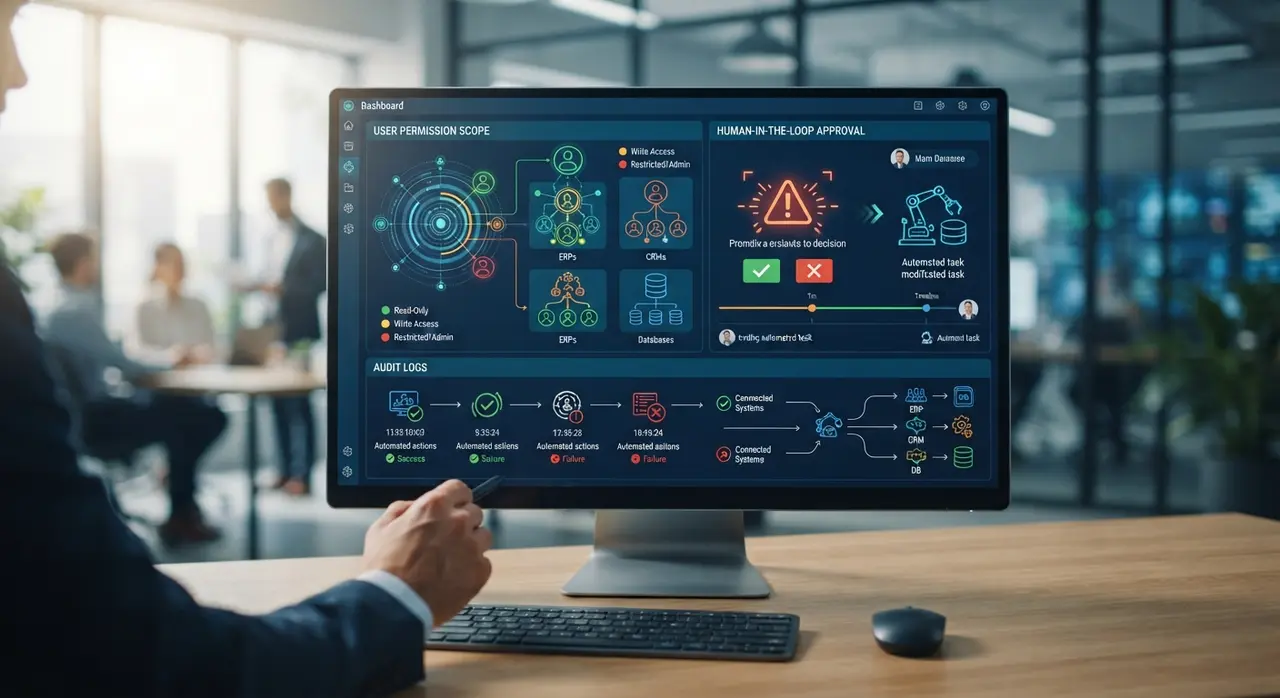
- OAuth 2.0 & Scope Delegation: Agents must execute actions using dedicated service accounts granted minimum necessary privileges (Principle of Least Privilege). An account manager agent should have
read/writeaccess to CRM leads, but zero access to payroll accounting modules. - API Gateway Isolation: Place an API gateway between the AI agent orchestrator and backend microservices. The gateway handles TLS termination, authentication header injection, and parameter scrubbing.
- Strict Rate Limiting: Enforce throughput limits per function call type to prevent accidental infinite loops where an agent recursively calls database write functions in seconds.
- Immutable Audit Logging: Capture every natural language prompt, generated JSON payload, user session ID, execution latency, and return status in centralized log analytics tools for compliance audits.
Preventing Hallucinations: Schema Validation and Human-in-the-Loop Safeguards
Function calling dramatically reduces AI hallucination by constraining model output to strict JSON schemas, but logic errors can still occur if context is ambiguous. Mitigating operational risk requires a dual layer of deterministic validation and human intervention checkpoints.
Deterministic validation uses strict middleware logic to verify that arguments generated by the model actually exist in core systems. For instance, if an LLM generates a function call to delete an invoice using an ID extracted from conversational context, the middleware verifies whether the user holds explicit authorization rights for that tenant ID before making the API invocation.
For high-risk operations—such as approving wire transfers, firing bulk email campaigns, or modifying master vendor records—companies enforce a Human-in-the-Loop (HITL) pattern:
- The AI agent parses the natural language request and generates the structured JSON call.
- The orchestrator halts execution and posts an interactive confirmation card to Microsoft Teams, Slack, or a dedicated dashboard.
- A authorized human manager reviews the visual parameters (e.g., recipient name, invoice sum, discount applied).
- Upon manual approval click, the orchestrator completes the API request to the ERP system.
Comparing Integration Architectures
Architecting autonomous workflows requires selecting the right balance between native model tools, deterministic logic platforms, and multi-step agent frameworks. The table below details how these technical approaches handle function execution across corporate IT environments.
| Evaluation Criterion | Native Model Function Calling | Workflow Automation Engines | Autonomous Agent Chaining |
|---|---|---|---|
| Execution Engine | Direct LLM JSON output generation | Fixed, deterministic rule graphs | Dynamic dynamic multi-step agent reasoning |
| Handling Ambiquity | High; extracts parameters from natural text | Low; requires strict structured triggers | Very High; asks clarifying questions automatically |
| Multi-Step Capabilities | Single-turn output per prompt cycle | Pre-defined linear branching paths | Dynamic loop orchestration based on intermediate state |
| Security Isolation | Requires custom external gateway wrapper | Built-in connector credential management | Requires custom governance policy engines |
| Best Enterprise Use Case | Quick contextual data retrieval & single actions | Static process automation across webhooks | Complex cross-department operations in SAP / Salesforce |
Multi-Step Function Chaining for Complex Operational Workflows
Real enterprise processes are rarely single-step actions; they require multi-step function chaining where the output of one API call informs the inputs of the next. AI agents execute complex multi-system workflows by maintaining an execution graph and intermediate context memory.
For example, resolving a customer return request involves several interconnected tasks:
- Querying CRM: Fetch customer purchase history to confirm return policy eligibility.
- Checking ERP Inventory: Verify whether replacement items exist in nearby fulfillment centers.
- Creating Return Ticket: Invoke the service desk API to generate a shipping label.
- Triggering ERP Refund: Issue a credit memo through financial accounting services.
During function chaining, if step two reveals zero stock in the local warehouse, the agent dynamically adjusts its plan. Instead of pushing a replacement order, it calls an alternative function to issue a credit voucher, demonstrating operational agility while strictly operating within business rules. You can review how this operates across distributed logistics nodes in our guide on process standardization with AI for multi-unit operations.
Real-World Mini-Case: Multi-Unit Financial Diagnostics
A multi-unit retail franchise operating 45 locations suffered severe operational bottlenecks due to manual end-of-week financial reconciliation. Store managers submitted unstructured spreadsheets via email, forcing central accounting teams to manually parse tables, verify transaction IDs, and input data into legacy ERP software—a process taking 18 hours weekly with frequent entry errors.
By implementing a custom AI agent solution designed alongside Agentes Autônomos, the company automated the entire ingestion pipeline. An autonomous agent now reads incoming franchisee reports, uses function calling to validate sales numbers against transaction logs in a PostgreSQL database, highlights discrepancies over 2%, and triggers automated ERP line-item entries.
The qualitative outcome was immediate: weekly reconciliation turnaround dropped from 18 hours to under 15 minutes, manual input errors were completely eliminated, and store managers gained real-time visibility into branch profit margins. To explore how your organization can achieve similar speed, feel free to schedule an automation diagnosis with our technical team.
Frequently asked questions
What is the difference between an API and function calling in AI?
An API (Application Programming Interface) is the backend software bridge that accepts structured commands and returns data. Function calling is the AI capability where an LLM translates natural language instructions into the exact JSON format required to trigger an API request.
Can AI agents execute function calls directly without developer integration?
No, native function calling only generates the structured JSON parameters describing what action should be taken. Developers must build or deploy middleware logic that takes that JSON payload, sends it to the destination database or system, and passes the response back to the agent.
How does function calling prevent AI from modifying critical database records by mistake?
Database safety is enforced by schema validation, role-based access control (RBAC), and Human-in-the-Loop (HITL) authorization steps. Critical endpoints like record deletion or financial transactions require human approval before execution regardless of what the LLM outputs.
Which enterprise systems can be connected via function calling?
Any software platform that exposes REST APIs, GraphQL endpoints, gRPC interfaces, or direct SQL database connectors can accept function calls from an AI agent. Common enterprise applications include SAP, Salesforce, Oracle, Hubspot, Zendesk, and custom SQL/NoSQL databases.