Claude GPT or Gemini: Which AI Model for Enterprise in 2026
Compare Claude, GPT, and Gemini for tailored enterprise automation in 2026. Discover multi-model routing, function calling, and zero-vendor lock-in strategies.
- Enterprise AI
- Claude GPT or Gemini
- Process Automation
- AI Governance
- Multi-Model Architecture
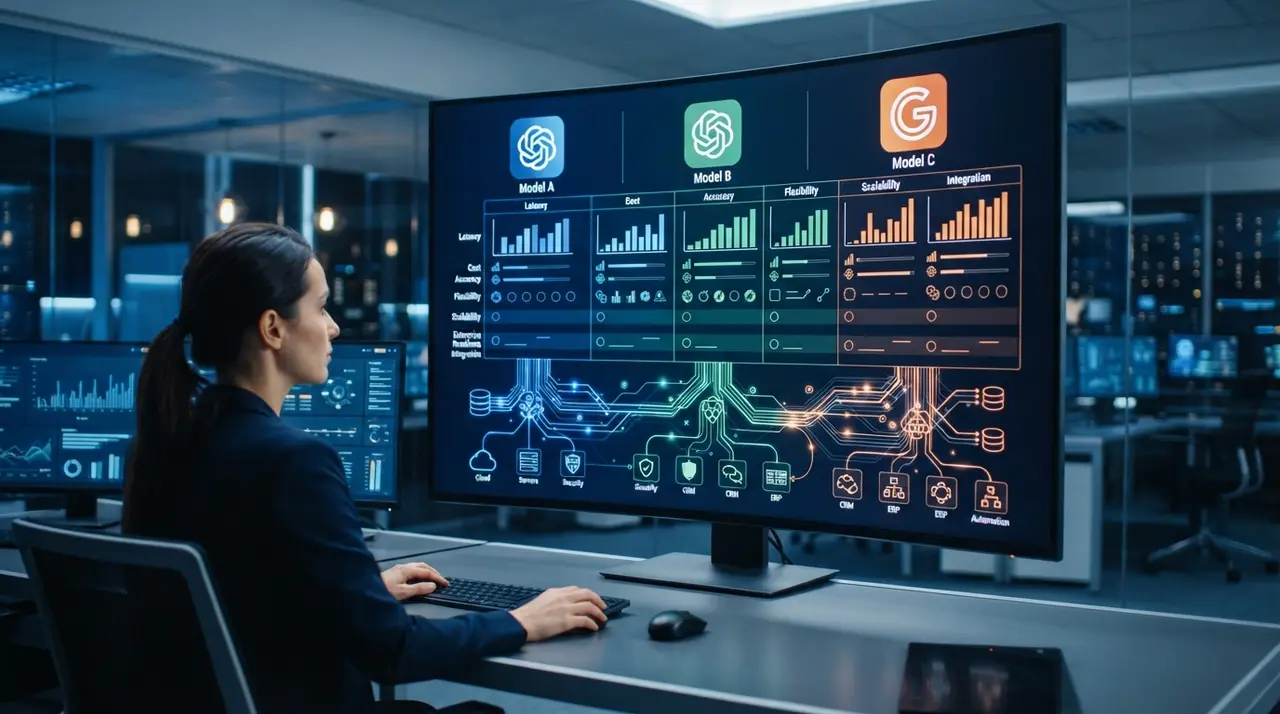
Selecting between Claude, GPT, or Gemini for custom enterprise automation in 2026 requires evaluating specific operational requirements like function calling reliability, latency, context caching, and data privacy rather than relying on public benchmark scores. While Anthropic's Claude excels in complex logical reasoning and structured output, OpenAI's GPT leads in ecosystem integration and rapid function execution, and Google's Gemini offers superior long-context processing for massive document analysis.
For business owners and operations leaders deciding qual modelo de IA best suits their enterprise workflows, the core challenge is not picking a single winning LLM. Instead, the real goal is building a scalable, model-agnostic infrastructure tailored sob medida em 2026 to reduce backlog, eliminate manual rework, and maintain strict governance across all units.
Benchmarks vs. Production Reality: Evaluating Enterprise Models in 2026
Public AI benchmarks fail to accurately predict enterprise automation performance because they do not measure multi-step system stability, API reliability, or ERP integration success. A model scoring 90% on an academic logic leaderboard can easily break down when forced to handle dirty input data from legacy software or parse ambiguous customer inquiries sent via WhatsApp.
When deploying autonomous agents across finance, procurement, customer service, or logistics, enterprise decision-makers must look beyond marketing claims and evaluate foundational models across six core production criteria:
- Structured Reason & Logic: How reliably the model follows complex, multi-branch business rules without hallucinating policies or missing critical steps.
- Function Calling Reliability: The precision with which the AI formats JSON parameters to trigger APIs, query databases, and update CRM records automatically.
- Context Window & Caching: The capacity to process massive contracts, transaction histories, or technical documentation at reasonable token costs.
- Latency & Throughput: Operational speed for time-sensitive tasks, such as real-time customer support or live inventory checking.
- Data Privacy & Sovereignty: Support for zero-data retention policies, regional data residency, and dedicated virtual private cloud (VPC) deployments.
- Token Economics: Total cost of ownership (TCO) at scale, balancing prompt input costs against response volume.
Deep Dive Comparison: Claude, GPT, and Gemini Strengths
Enterprise deployment requires matching specific foundational model strengths to distinct operational tasks across sales, finance, and logistics. No single model provider dominates every operational dimension, making a clear breakdown essential for tech leadership.
Anthropic Claude (Claude 3.5 Sonnet / Claude 3.7)
Anthropic has positioned the Claude family as the premier choice for complex cognitive work, code generation, and rigorous document analysis. Its standout capability lies in strictly following extended operational guidelines without breaking character or violating system constraints.
In production, Claude shines in high-compliance workflows like processing legal agreements, underwriting claims, and generating precise structured data from unstructured sources. Its nuanced understanding of human intent makes it exceptionally strong when managing delicate customer negotiation or multi-stage customer service escalations.
OpenAI GPT (GPT-4o / o3 Series)
OpenAI remains the industry benchmark for developer ecosystem integration, tool calling speed, and raw conversational versatility. Models like GPT-4o offer fast response times coupled with ultra-reliable function execution across diverse enterprise APIs.
GPT models are often the default choice for high-volume operational routing, automated CRM updates, and interactive internal copilots. When your workflow requires fast API response times and robust integration with existing third-party SaaS applications, GPT delivers consistent production stability.
Google Gemini (Gemini 1.5 Pro / 2.0 Series)
Google's Gemini ecosystem brings unique advantages in context capacity and native multimodality. With standard context windows reaching up to two million tokens, Gemini can analyze entire financial audit files, video logs, or extensive code bases in a single prompt call.
Furthermore, Gemini's deep integration with Google Cloud Platform (GCP) and highly competitive context caching rates make it ideal for document-heavy operations, automated invoice auditing, and multi-unit supply chain analytics where large historical datasets must be reviewed simultaneously.
Technical Criteria Matrix for Enterprise Decision-Makers
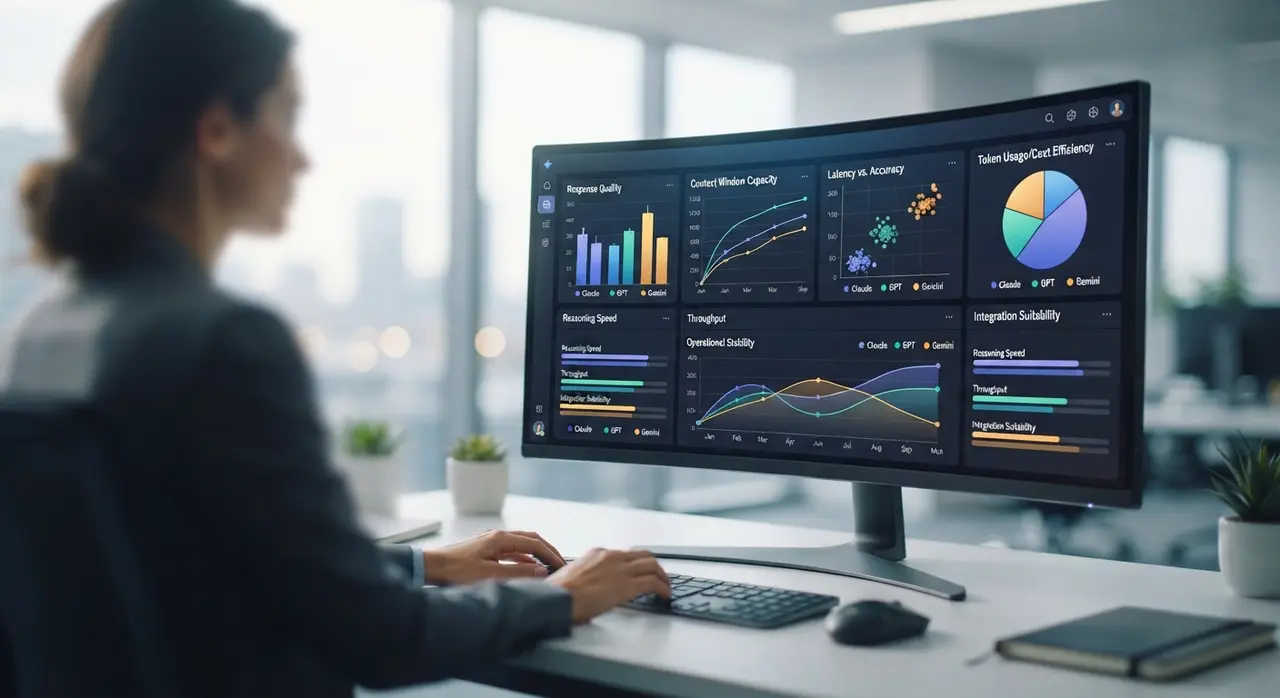
Objective evaluation across technical parameters ensures optimal balance between inference cost, processing speed, and execution accuracy. The following matrix details how the three leading model families compare across enterprise production metrics in 2026:
| Evaluation Criterion | Anthropic Claude | OpenAI GPT | Google Gemini |
|---|---|---|---|
| Primary Enterprise Strength | Complex logical reasoning & structured output | Tool calling speed & ecosystem integration | Massive context windows & multimodal ingestion |
| Function Calling Precision | Very High (Strict JSON compliance) | Extremely High (Native API integration) | High (Strong schema execution) |
| Context Capacity | 200,000+ Tokens | 128,000+ Tokens | 1,000,000 to 2,000,000+ Tokens |
| Token Caching Cost Benefit | High efficiency on repetitive system prompts | Moderate discount structures | Industry-leading cost reduction for massive context |
| Deployment Flexibility | AWS Bedrock, GCP Vertex, Anthropic API | Azure OpenAI Service, OpenAI API | Google Cloud Vertex AI, Native API |
Understanding these subtle trade-offs allows managers to configure accurate triggers. For instance, when function calling AI agents execute enterprise tasks, using the model best suited for structured API extraction minimizes failure rates in critical business logic.
Multi-Model Routing: Avoiding Single-Vendor Lock-In
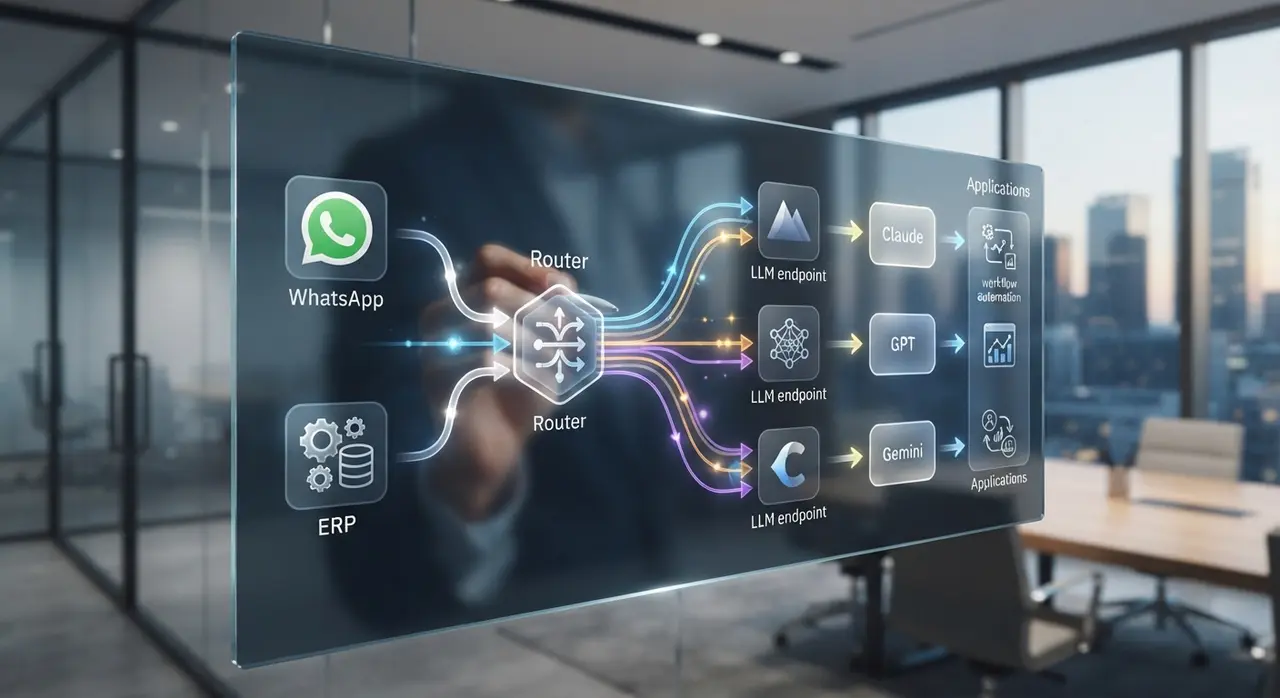
Routing specific tasks to different foundation models dynamically reduces operational expenditure by up to 60% while eliminating vendor lock-in risks. Relying on a single AI provider leaves an enterprise vulnerable to service outages, price changes, or unexpected shifts in model behavior following minor API updates.
A modern enterprise architecture uses an intelligent middleware orchestration layer to direct tasks based on difficulty, latency requirements, and cost boundaries:
- Tier 1 Ingestion: A lightweight, low-cost model (e.g., GPT-4o mini or Gemini Flash) scans incoming emails, WhatsApp messages, or documents to classify the request and extract initial metadata.
- Tier 2 Heavy Execution: If the task involves multi-page document validation or complex policy interpretation, the orchestrator routes the payload to Claude Sonnet or Gemini Pro.
- Tier 3 Deterministic Action: Once logic is validated, a fast, tool-optimized model or explicit Python execution script executes the actual ERP or CRM transaction.
Data Sovereignty: Public APIs, Private Cloud, and Open Source
Enterprise data sovereignty demands strict isolation mechanisms to ensure regulatory compliance and protect intellectual property. Operating under strict privacy standards means company records, customer details, and proprietary trade secrets must never be used to train public foundation models.
Business leaders generally select from three primary deployment architectures:
- Enterprise Public APIs (with Zero Data Retention): Contracting directly with providers like OpenAI, Anthropic, or Google under SOC2 Type II compliance terms where incoming prompts are explicitly excluded from model training.
- Hyperscale Cloud Deployments (Azure OpenAI, AWS Bedrock, GCP Vertex AI): Running models inside your enterprise's existing cloud perimeter, keeping data strictly contained within your corporate network boundaries.
- Self-Hosted Open-Source Models (Llama 3, DeepSeek, Mistral): Hosting open weights on private GPU clusters for absolute data sovereignty, ideal for ultra-sensitive sectors like defense, financial services, or healthcare.
Establishing clear governance guidelines early protects your operations against liability, which is why negotiating an AI automation SLA essential clauses document is critical prior to enterprise-wide rollout.
Case Study: Multi-Unit Operational Efficiency with Agentes Autônomos
Implementing dynamic multi-model orchestration enabled a multi-unit distribution company to automate order processing and eliminate operational bottlenecks without replacing their existing legacy ERP. The client operated across 14 regional units, struggling with delayed customer responses on WhatsApp and manual billing data entry that created order backlogs.
Working alongside Agentes Autônomos, the client deployed a multi-model agentic solution designed for their operational structure:
- The Challenge: Manual extraction of purchasing details from unstructured emails and incoming WhatsApp PDFs created a 6-hour delay in order entry, causing frequent inventory allocation mistakes.
- The Solution: Agentes Autônomos deployed an intelligent orchestration pipeline using Gemini for instant PDF scanning and context extraction, paired with Claude for multi-unit pricing validation and rules verification. GPT handled fast API updates directly into the legacy ERP.
- The Result: Order processing times dropped from 6 hours down to under 3 minutes, human input errors fell by 94%, and zero changes were required to the company's legacy software infrastructure.
By leveraging tailored autonomous agent solutions, the company scaled operational capacity without adding headcount overhead.
Orchestration and Integration Matter More Than Model Choice
System architecture and middleware design determine 80% of an automated workflow's success, whereas model selection accounts for the remaining 20%. Even the world's most intelligent LLM will produce operational errors if it lacks access to clean database records, structured prompt guardrails, or explicit state management.
To guarantee business continuity, enterprise AI implementations must incorporate robust governance layers:
- Human-in-the-Loop (HITL) Gateways: Automatic routing triggers human intervention whenever model confidence scores drop below strict operational thresholds.
- State Management & Memory: Preserving transactional history across multi-day operations without bloating token usage or losing core business context.
- Fallback & Circuit Breakers: Automatic failover systems that switch execution to a backup model or fallback script if an API provider experiences downtime.
- Deterministic Validation Layers: Using strict schema validators (like Pydantic or JSON Schema) to reject malformed data before it reaches production databases.
Conclusion: Building a Model-Agnostic Enterprise AI Strategy
A resilient enterprise AI architecture leverages the unique advantages of multiple models while maintaining full control over business rules and integrations. Winning companies in 2026 will not be those that locked themselves into a single model vendor, but those that built flexible, model-agnostic automation ecosystems.
By selecting the right foundation model for each specific task, implementing dynamic routing, and maintaining strict human-in-the-loop oversight, your business can reduce costs, eliminate operational friction, and scale efficiently.
Frequently asked questions
Should my company pick just one AI model vendor for all operations?
No, committing to a single model provider increases vendor lock-in risks and leads to sub-optimal operational performance. Building a model-agnostic architecture lets you route individual tasks to the most cost-effective and capable AI model dynamically.
How do AI agents integrate with our legacy ERP and CRM systems?
AI agents connect to existing systems using REST APIs, webhooks, database connectors, or middleware automation layers. They process inputs and execute standard software actions directly without requiring you to replace your established software stack.
How is corporate data kept private when using models like Claude, GPT, or Gemini?
Enterprise data privacy is maintained by utilizing enterprise-grade API agreements with strict zero data retention policies or by deploying models via enterprise cloud environments like Azure OpenAI, AWS Bedrock, or GCP Vertex AI where prompts are isolated and never used for model retraining.