
AI Agents with Long-Term Memory & Context Persistence
Learn how AI agents with long-term memory and context persistence transform enterprise automation, cutting rework and streamlining CRM and ERP workflows.
- AI Agents
- Long-Term Memory
- Context Persistence
- Enterprise Automation
- AI Governance

AI agents with long-term memory utilize vector databases, episodic logs, and semantic knowledge bases to preserve operational context across months of customer and organizational interactions. Understanding how context persistence transforms enterprise automation is essential for replacing disjointed, single-session chatbots with intelligent digital workers that integrate natively with existing CRMs, ERPs, and WhatsApp channels.
The Core Limitation of Pure Large Language Models
Standard Large Language Models (LLMs) operate in a stateless environment, meaning every conversation resets to zero once a session terminates. Without persistent memory, an LLM treats a returning high-tier client or a recurring operational exception as an entirely new event, forcing human operators or customers to re-explain their context repeatedly.
This absence of historical awareness introduces friction, inflates resolution times, and damages brand trust. In high-volume operations like multi-unit logistics or enterprise customer service, stateless interactions result in excessive manual rework and fragmented operational visibility across business units.
How Context Persistence Transforms Enterprise Automation Architectures
Context persistence transforms enterprise automation by separating immediate conversational processing from long-term dynamic storage. Modern autonomous agent architectures combine three distinct layers of memory to deliver cohesive operational continuity across systems.
- Episodic Memory: Stores sequences of specific past events, user choices, and historical interaction logs to understand conversation trajectories over time.
- Semantic Memory: Maintains general domain knowledge, company policies, business rules, and specific facts about accounts or organizational units.
- Working (Short-Term) Memory: Holds current conversation state and active variables required to complete immediate tasks via function calling tools.
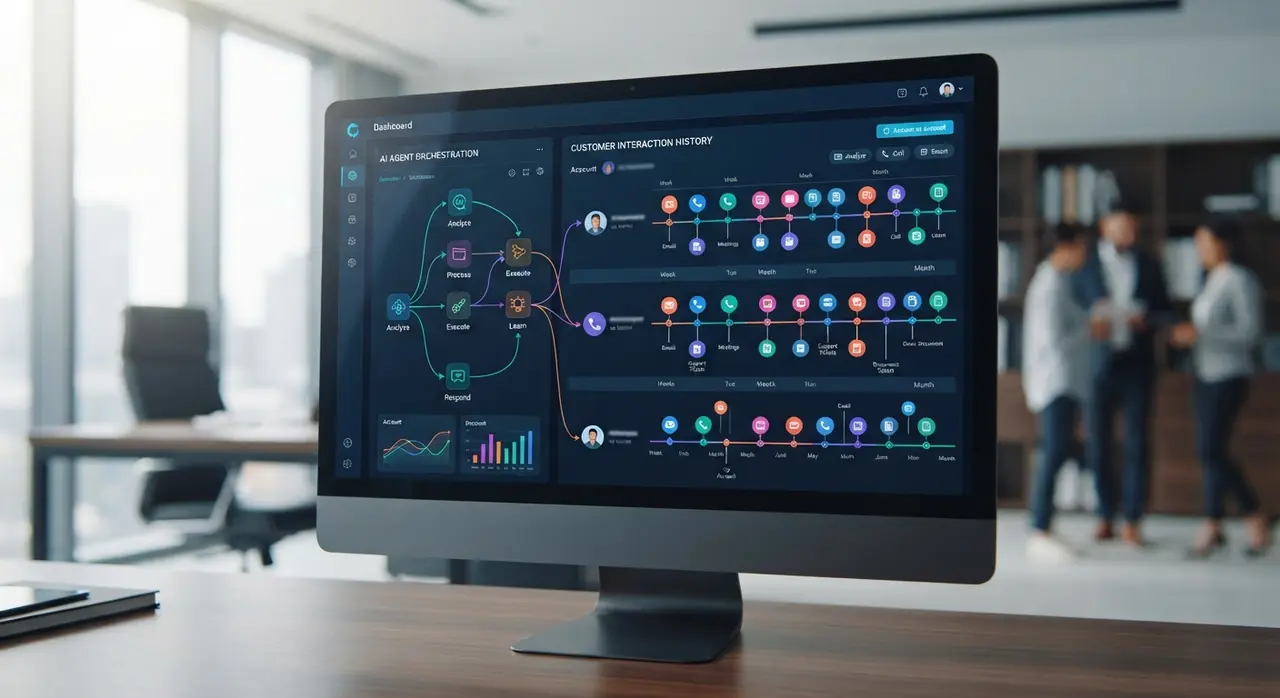
By leveraging Retrieval-Augmented Generation (RAG) combined with high-density vector embeddings, the agent queries persistent stores in real time. This ensures every operational decision reflects both historical data and real-time enterprise system updates.
| Memory Architecture | Storage Mechanism | Primary Enterprise Benefit | Typical Use Case |
|---|---|---|---|
| Stateless (Base LLM) | Prompt context window only | Instant generation without database overhead | One-off text summaries |
| Session Memory | In-memory active cache | Short-term conversation continuity | Basic chat interaction |
| Long-Term Persistent Memory | Vector DBs + Knowledge Graphs | Cross-channel context, zero repeated questions | End-to-end B2B operations |
Eliminating Rework Across Key Business Units
When AI agents with memory operate within core business workflows, efficiency gains extend well beyond simple chat responses. Operational units experience a structural drop in repetitive inquiries and process bottlenecks.
In Customer Support & Sales, persistent agents recall previous ticket escalations, contract terms, and client preferences across WhatsApp, email, and web portals. The client never repeats account details, and the agent proactively suggests relevant follow-ups based on past interactions.
In Procurement & Finance, autonomous agents track recurring vendor discrepancies, credit terms, and historical approval cycles. They detect operational anomalies early, routing non-standard invoices to human supervisors with full contextual summaries attached.
Governance, Privacy, and Compliance for Persistent Context
Storing operational context across extended timelines requires rigorous data governance and security frameworks. Enterprise leaders must define explicit rules regarding what memory records are retained, where they are hosted, and who maintains access.
To satisfy regulatory frameworks like LGPD and GDPR, systems must implement granular data retention policies and exact mechanisms for the "right to be forgotten." When an account requests data removal, the architecture must scrub both structured relational records and vector database embeddings without destabilizing the agent's core semantic knowledge.

A well-structured corporate implementation includes strict role-based access controls (RBAC) and data anonymization layers. Performing a comprehensive AI automation diagnosis helps companies identify regulatory boundaries before scaling persistent memory systems across sensitive financial or HR departments.
Real-World Case Study: Multi-Unit Operations with Agentes Autônomos
A regional B2B distributor managing six distribution hubs faced high ticket resolution times due to fragmented customer interactions across WhatsApp and email. Support teams spent up to 35% of their day reviewing past order histories and re-asking clients for purchase order details.
By deploying tailored AI solutions built by Agentes Autônomos, the distributor implemented a long-term memory layer integrated directly with their ERP and WhatsApp Business API. The persistent agent recognized returning buyers instantly, retained multi-unit branch shipping preferences, and managed routine reorders autonomously.
As a result, average resolution times plummeted by over 60%, manual data entry errors fell to near zero, and human operators stepped in only for complex, high-value contract negotiations backed by complete agent summaries.
Frequently asked questions
What is the main difference between session context and long-term memory?
Session context holds active conversation data only while an interaction is live, clearing as soon as the session closes. Long-term memory persists user preferences, interaction history, and enterprise facts indefinitely across multiple channels and dates using vector databases and structured knowledge stores.
How do AI agents with long-term memory handle data privacy laws like LGPD or GDPR?
Enterprise AI agents implement privacy by design through encrypted vector stores, role-based access control, and automated data retention policies. When a user requests data deletion, dedicated deletion pipelines erase both traditional records and corresponding vector embeddings to honor the right to be forgotten.
Does adding long-term memory require replacing our current ERP or CRM?
No, persistent context layers operate alongside your existing systems without requiring core infrastructure replacement. AI agents connect to your current ERP, CRM, and communication tools via standard APIs and webhooks to store and retrieve contextual memory independently.
How does human-in-the-loop oversight work with autonomous memory agents?
Human supervisors review agent logs through centralized dashboards when actions exceed predefined confidence thresholds or risk limits. Human feedback and corrections are saved into the agent's episodic memory store, continuously refining future automated decisions.