
AI Agent Vendor Checklist: Technical & Commercial Guide
Evaluate AI agent vendors effectively using this technical and commercial checklist. Assess LGPD compliance, SLAs, pricing models, and human-in-the-loop AI.
- AI Vendor Evaluation
- Enterprise AI Governance
- Process Automation
- AI Agent Checklist
- Commercial Diligence

Evaluating an autonomous AI agent vendor requires analyzing both technical architecture and commercial terms to prevent integration failures and financial overruns. A structured checklist para avaliar fornecedor de agentes allows enterprise leaders to verify data privacy, hallucination controls, human-in-the-loop governance, and total cost of ownership before signing a contract. Deploying intelligent automation across sales, finance, customer service, or logistics should optimize operations without requiring a complete overhaul of your existing technology stack.
Many organizations jump into artificial intelligence initiatives based solely on polished product demonstrations. However, a successful deployment depends on rigorous due diligence regarding backend stability, security frameworks, and vendor accountability. Asking precise perguntas técnicas e comerciais early ensures that your team partners with a provider capable of delivering scalable, enterprise-grade results.
1. Data Security and Governance Standards in AI Vendor Selection
Securing enterprise data requires AI vendors to implement strict encryption, isolated data tenancy, and full compliance with privacy regulations like LGPD and GDPR. When granting an autonomous agent access to internal databases, enterprise resource planning (ERP) platforms, or customer relationship management (CRM) tools, data leakage risks must be mitigated at every layer.
To safeguard your operational intelligence and sensitive customer records, your evaluation team must audit how the vendor processes and stores information. Ask the vendor the following technical security questions:
- Is customer data used to train foundation models? Verify that your proprietary operational data remains strictly isolated and is never fed back into public large language models (LLMs).
- Where is the data hosted and how is it encrypted? Confirm that data in transit uses TLS 1.3 encryption and data at rest relies on AES-256 standards, with clear geographical residency compliance.
- What access control controls exist? Ensure the platform supports Role-Based Access Control (RBAC), multi-factor authentication (MFA), and single sign-on (SSO) integration.
Without explicit, legally binding guarantees regarding data tenancy and model isolation, an enterprise exposes itself to compliance penalties and IP leaks. Reviewing security protocols alongside a comprehensive AI automation RFP selection guide helps formalize these requirements during procurement.
2. Technical Integration Architecture Without Legacy Replacement
Enterprise AI agents must integrate seamlessly into existing CRMs, ERPs, and WhatsApp stacks through robust APIs without forcing infrastructure overhauls. A primary value driver of autonomous agents is their ability to act as orchestrators across existing software, eliminating manual data entry between siloed systems.
When assessing a provider's architectural compatibility, examine how their agents communicate with legacy endpoints and handle traffic spikes:
- API and Webhook Support: Can the agents connect natively via REST or SOAP APIs to platforms like Salesforce, SAP, TOTVS, Zendesk, and WhatsApp Business API?
- Event-Driven Processing: Does the system trigger actions in real time based on database changes, webhooks, or scheduled job queues?
- System Failovers: How does the agent react when an underlying ERP endpoint suffers downtime or returns a timeout response?

A mature provider builds resilient abstraction layers. If an API call fails, the agent should queue the transaction, log the error, and notify the designated admin rather than dropping customer requests or creating duplicate database entries.
3. Controlling Hallucinations Through Human-in-the-Loop Safeguards
Eliminating hallucination risks requires AI vendors to establish strict confidence thresholds and immediate human escalation workflows. Uncontrolled LLMs can output incorrect pricing, wrong inventory counts, or unauthorized policies, leading to reputational and financial damage.
Your team must ensure the platform incorporates a deterministic guardrail framework. Rather than relying purely on generative outputs, high-stakes tasks must run through structured decision trees and policy validation engines.
- Confidence Scoring: The agent should compute a confidence score for every response. If confidence drops below a pre-set threshold (e.g., 85%), the ticket escalates to a human operator.
- Seamless Escalation: Human agents must receive full context, conversation history, and proposed AI answers within their standard service desk interface.
- Audit Logging: Every decision, retrieved document source, and API execution must be saved in an immutable audit log for compliance reviews.
By enforcing human-in-the-loop (HITL) checkpoints for sensitive workflows—such as issuing financial refunds or modifying purchasing orders—companies maintain total operational control while reducing manual labor across routine tasks.
4. Commercial Due Diligence: Evaluating Pricing Models and TCO
Understanding the total cost of ownership demands a full breakdown of platform fees, LLM token usage, maintenance costs, and scaling tiers. Navigating comerciais antes de contratar agreements requires peering beyond headline subscription rates to identify variable expenses that skyrocket with usage volume.
AI agent pricing generally falls into three operational structures:
- Fixed Monthly SaaS Fee: Predictable overhead covering platform maintenance, user licenses, and core support, though usage limits may apply.
- Usage-Based (Per Resolution or Token): Costs scale dynamically based on processed tickets, API executions, or token volume.
- Performance-Based (Gain-Share): Fees tie directly to business metrics, such as cost reduction per ticket or conversion rate increases.
Always inquire about hidden charges, such as setup fees, custom integration maintenance, third-party model pass-through costs, and data storage overages. Unclear pricing models often lead to budget overruns once transaction volumes scale across multiple operational units.
5. Essential SLA Clauses, Support Structure, and Exit Strategies
Contractual SLAs must guarantee system availability, response times for model drift, and clear data extraction policies upon contract termination. Autonomous agents operate in real-time execution environments; any unmanaged outage directly impacts business operations.
When reviewing contracts, insist on specific service level agreements and support parameters:
- Uptime Commitments: Require a minimum of 99.9% uptime for core agent execution engines.
- Response and Resolution SLAs: Define strict response timeframes based on severity levels (e.g., critical platform outages vs. minor prompt adjustments).
- Model Drift and Maintenance: The vendor must actively monitor vector databases, update fine-tuned models, and re-index knowledge bases as company policies evolve.
- Vendor Lock-in Prevention: Establish clear offboarding procedures ensuring all custom prompts, workflow mappings, and historical telemetry remain your property and can be exported cleanly upon termination.
For detailed legal structuring, consult our guide on essential AI contract clauses and SLAs to align performance guarantees with corporate compliance.
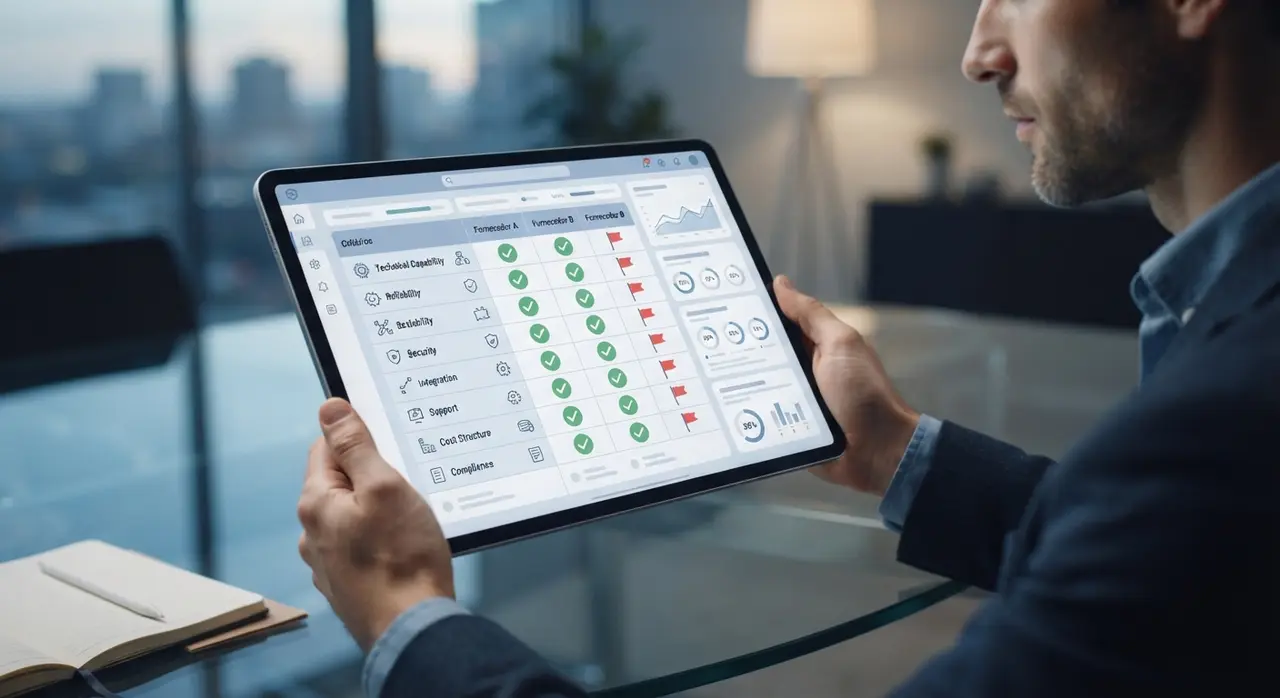
6. Vendor Evaluation Matrix: Superficial Providers vs. Enterprise Partners
A structured vendor comparison highlights critical differences in governance, scalability, transparency, and operational risk management. Using a comparative framework prevents organizations from selecting low-cost wrappers that fail under operational stress.
| Evaluation Dimension | Superficial AI Vendor | Enterprise-Grade AI Partner |
|---|---|---|
| Integration Depth | Basic Zapier/Webhook triggers with limited error handling. | Native API orchestration across CRM, ERP, and databases with failover queues. |
| Hallucination Management | Relies entirely on standard system prompts without validation rules. | Deterministic guardrails, confidence scoring, and structured human escalation. |
| Data Privacy & Security | Shared multi-tenant databases; unclear training data usage. | Isolated data tenancy, end-to-end encryption, and full LGPD/GDPR compliance. |
| Pricing Transparency | Opaque token markups and unexpected usage fees. | Predictable hybrid tiers with clear caps and transparent unit economics. |
| Maintenance & Support | Passive support desks with generic ticketing queues. | Proactive performance monitoring, model tuning, and managed post-implementation maintenance. |
7. Red Flags and Maturity Signals in AI Vendor Assessments
Identifying early warning signs prevents organizations from investing in proprietary technical black boxes or single-developer dependencies. Evaluating an AI partner requires separating true engineering maturity from marketing hype.
Critical Red Flags
- Promises Without Metrics: Claims of "100% resolution accuracy" or "instant deployment with zero human supervision."
- Refusal to Run a Proof of Concept (PoC): Vendors unwilling to demonstrate agent performance on your actual workflows using sanitized historical data.
- Single-Person Dependency: Small teams where model architecture and system maintenance rely entirely on a single key developer.
- Black-Box Operations: Software platforms that conceal decision logs, execution steps, and source documentation used for responses.
Enterprise Maturity Signals
- Comprehensive Audit Telemetry: Dashboards that track prompt performance, latency, agent step execution, and human handover rates.
- Modular Architecture: Capability to swap underlying LLM providers (e.g., OpenAI, Anthropic, open-source models) without re-engineering workflows.
- Verifiable Sector Case Studies: Demonstrated operational results within your industry, backed by client reference contacts.
8. How Agentes Autônomos Meets Enterprise Evaluation Standards
Agentes Autônomos delivers complete transparency across technical integration, human governance, predictable pricing, and proven operational KPIs. Built specifically for business leaders seeking measurable efficiency gains, our platform combines autonomous execution with absolute risk control.
Consider a multi-unit logistics client operating across several distribution hubs. The company faced chronic backlogs in delivery tracking updates and invoice processing, leading to high operational churn. By deploying customized autonomous agents integrated with their ERP and WhatsApp Business stack, Agentes Autônomos achieved the following outcomes:
- 70% Reduction in Support Backlog: Agents automatically validated dispatch statuses and issued tracking links in real time.
- Zero ERP Overwrite Errors: Strict human-in-the-loop workflows flagged anomalous billing discrepancies for supervisor approval before updating backend tables.
- Immediate ROI: Full operational rollout completed within four weeks without replacing existing legacy software.
We invite decision-makers to test our architectures against the most demanding criteria. Explore real-world applications in our catalog of real-world automation examples to see how customized agents fit your specific operational bottlenecks.
Frequently asked questions
What is the most important technical criterion when evaluating an AI agent vendor?
Data security and system integration capability are the most critical technical criteria. Ensure the vendor guarantees data tenancy isolation, end-to-end encryption, and native API compatibility with your existing CRM, ERP, and messaging infrastructure.
How do autonomous AI agents handle incorrect or hallucinated responses?
Enterprise AI agents utilize confidence scoring algorithms and deterministic guardrails to prevent hallucinations. When an agent's confidence score drops below a designated safety threshold, the request automatically routes to a human operator alongside the full interaction history.
What commercial pricing model is safest for enterprise AI deployment?
A predictable hybrid pricing structure combining a fixed operational platform fee with clear, capped per-resolution metrics offers the highest stability. This approach aligns software costs directly with operational output while protecting your budget against sudden traffic spikes.
Can AI agents work with legacy ERPs without changing existing infrastructure?
Yes, enterprise-grade AI agents integrate through REST/SOAP APIs, database connectors, or middleware webhooks without altering core legacy databases. This abstraction layer enables autonomous automation while preserving your existing IT infrastructure investment.