AI Automation SLA: Essential Clauses Before Signing
A Service Level Agreement (SLA) in AI automation projects requires specialized clauses to mitigate model drift, integration risks, and operational downtime.
- AI Governance
- Service Level Agreement
- Process Automation
- Enterprise AI
- AI Risk Management

A Service Level Agreement (SLA) in AI automation projects establishes measurable operational metrics, liability bounds, and performance benchmarks between enterprise buyers and AI vendors. Drafting a comprehensive SLA in AI automation projects requires clauses that address non-deterministic model behavior, third-party API dependencies, data governance, and model drift before signing any vendor contract.
Generic software contracts focus heavily on server uptime while completely ignoring decision accuracy, edge cases, and continuous model degradation. When enterprise teams integrate AI agents into core workflows across customer support, sales, finance, and operations, relying on a standard cloud contract creates severe operational vulnerabilities.
Infrastructure SLA vs. Business Outcome SLA
Infrastructure SLAs measure baseline technical uptime, whereas business outcome SLAs guarantee operational accuracy and workflow execution standards. A balanced contract before signing must bridge both technical availability and operational performance.
Traditional software contracts guarantee that servers remain online 99.9% of the time. However, an AI agent can maintain 99.9% cloud uptime while hallucinating customer responses, failing database writes in your ERP, or stalling multi-unit workflows. Evaluating these differences before committing to a vendor prevents unexpected operational friction and protects revenue.
| SLA Category | Focus Area | Key Metrics | Risk Mitigated |
|---|---|---|---|
| Infrastructure SLA | System uptime and API availability | Server response time, platform availability (e.g., 99.5%) | System outages and cloud crashes |
| Business Outcome SLA | Execution accuracy and process throughput | Task accuracy rate, fallback rate to humans, turnaround time | Hallucinations, workflow stalls, and corrupt data entry |
| Governance SLA | Model stability and data compliance | Retraining speed, drift detection, data sovereignty | Model performance degradation and privacy breaches |

Core Performance Metrics Every AI Contract Must Define
Essential performance metrics for autonomous agents include availability thresholds, incident response times by severity level, minimum accuracy guarantees, and model drift response windows.
When reviewing essential clauses that must be included in the agreement, enterprise buyers must define key performance indicators (KPIs) that reflect true operational reliability. Aligning these parameters ensures that both executive leadership and technical managers share clear operational expectations.
- Agent Uptime & API Reachability: Standard platform availability guarantees (e.g., 99.5% uptime) covering both the AI orchestration engine and connected messaging channels like WhatsApp, CRMs, and ERPs.
- Incident Severity & Response SLA: Clear time-to-respond and time-to-resolve targets categorized by operational impact (e.g., Priority 1 critical workflow halts resolved within 2 hours).
- Minimum Task Accuracy Rate: A defined benchmark (e.g., 95% correct field parsing or transaction routing) before automated actions trigger human escalation. For deeper details on operational roles, explore our guide on AI agent support and maintenance.
- Human-in-the-Loop Handover Time: Maximum response time when an agent encounters an edge case and safely transfers the session to a human operator.
Critical Governance and Exit Clauses Often Omitted
Protecting operational continuity requires binding contract clauses for model drift management, third-party integration liabilities, data ownership, and offboarding protocols.
Many enterprises experience unexpected service degradation months after implementation due to underlying model updates, modified ERP schemas, or third-party messaging policy shifts. Contracts that fail to address these variables leave operations vulnerable to untracked failures and scope creep.
To build a resilient operational foundation, ensure your contract incorporates these four non-negotiable legal and operational provisions:
- Model Drift and Prompt Maintenance: Language models shift over time as foundation providers release updates. Your contract must define who monitors performance drift, how often prompts are recalibrated, and who bears the cost of model fine-tuning.
- Third-Party Integration Liability: AI agents rely on external APIs like WhatsApp Business, Salesforce, or SAP. The SLA must distinguish between core AI failures and third-party downtime, establishing automated retries and fallback procedures when external systems drop offline.
- Data Ownership and Privacy Rights: The contract must explicitly state that all transactional data, company documentation, fine-tuning datasets, and prompt logs remain 100% enterprise property. Vendor models must never be trained on your proprietary operational data without explicit consent.
- Exit Strategy and Workflow Portability: Avoid vendor lock-in by mandating that workflow logic, custom prompt templates, and integration mappings are returned in standardized formats upon contract termination. Learn how to pre-evaluate these requirements in our AI automation diagnosis and risk mapping framework.
Case Study: Standardizing AI Governance in Multi-Unit Retail Operations
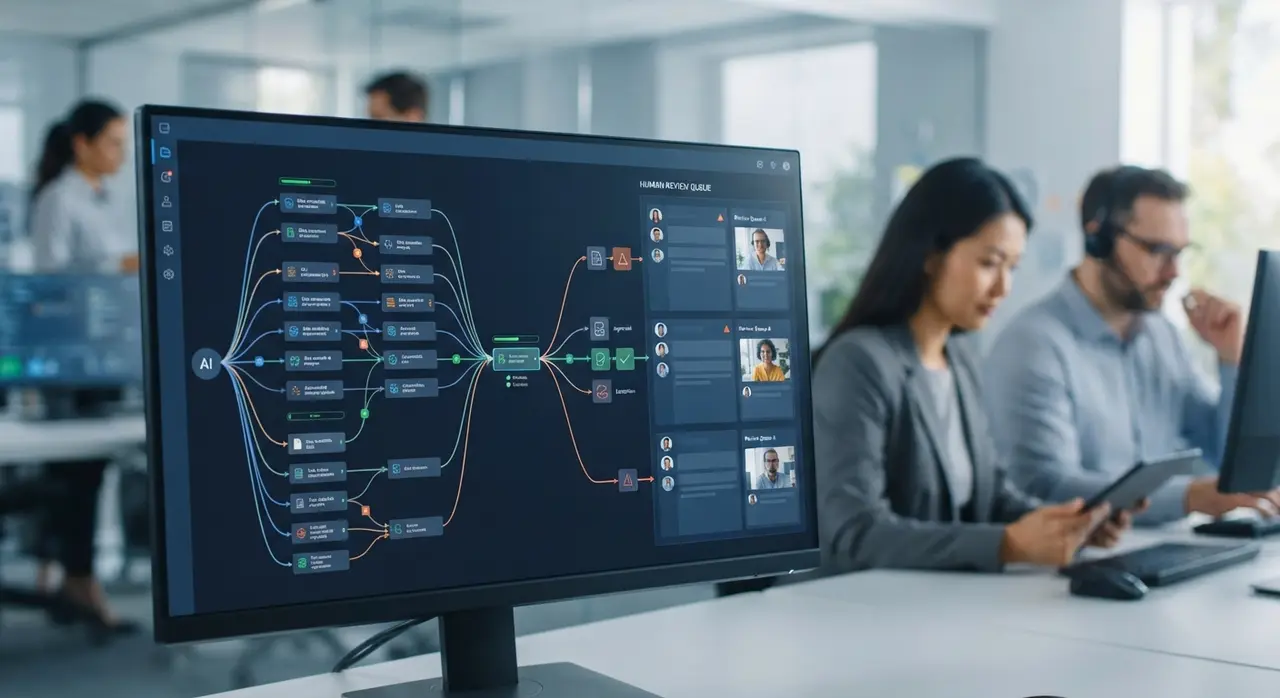
Establishing structured SLAs with Agentes Autônomos enabled a multi-unit retail enterprise to reduce order processing errors by 90% while maintaining absolute system uptime.
A regional retail network operating across 35 locations struggled with high order processing delays and manual data entry errors between WhatsApp customer inquiries and their ERP environment. Previous automation attempts failed due to unclear vendor response times during system updates and frequent unhandled exception errors.
By implementing custom AI agents built by Agentes Autônomos, the company deployed a clear outcome-based SLA featuring a 98% direct-parsing accuracy guarantee and automated human-in-the-loop exception handling. Within 60 days, order processing velocity quadrupled, customer waiting times dropped from 45 minutes to under 2 minutes, and operational managers gained complete transparency over process metrics. Explore similar operational transformation patterns in our real-world automation examples library.
Frequently asked questions
What is the difference between an SLA for traditional software and an SLA for AI automation?
Traditional software SLAs measure basic server uptime and infrastructure availability. An SLA for AI automation must also measure execution accuracy, model drift response windows, hallucination limits, and human fallback performance. This ensures that the agent delivers high-quality business outcomes, not just continuous uptime.
How should accuracy rates be calculated in an AI automation contract?
Accuracy rates are measured by comparing the agent's automated outputs against predefined validation rules or human review benchmarks. The contract should specify sample size, review frequency, and acceptable error thresholds. If accuracy falls below the agreed threshold, the vendor must trigger mandatory model recalibration without extra fees.
Who is responsible when a third-party API like WhatsApp or an ERP fails?
The SLA must explicitly separate core AI platform failures from third-party API downtime. However, the vendor remains responsible for implementing automated retry mechanisms, error logging, and graceful fallbacks to prevent data loss during third-party service disruptions.
What penalties should be included in an enterprise AI automation SLA?
Effective SLAs balance service credits for missed availability or response targets with earn-back incentives for exceeding accuracy benchmarks. Penalty structures typically grant service fee discounts when resolution windows are breached or model drift goes uncorrected beyond agreed timelines.