AI Automation RFP: How to Select an Intelligent Agent Vendor
Learn how to structure an AI automation RFP to evaluate intelligent agent vendors, control project risks, and ensure seamless enterprise integration.
- AI Automation RFP
- Vendor Selection
- Intelligent Agents
- AI Governance
- Enterprise AI

An AI automation RFP (Request for Proposal) is a structured procurement framework that enables enterprise leaders to evaluate, score, and select intelligent agent vendors based on objective operational, technical, and governance criteria. Structuring a formal process prevents apples-to-oranges proposal comparisons, ensuring that custom AI agents integrate into your existing ERP, CRM, and WhatsApp environments without forcing infrastructure overhauls.
Without a rigorous evaluation model, organizations often select vendors based on flashy demos rather than architectural fit, leading to unexpected integration costs, security vulnerabilities, and operational friction.
The Ideal Architecture of an AI Automation RFP
A well-crafted RFP must define the business problem while giving vendors room to propose innovative execution models. Rather than prescribing exact code parameters, specify operational outcomes, data flows, and required integration points across your business units.
To structure a comprehensive document, include these key sections:
- Business Context & Objectives: Detail current operational bottlenecks, transactional volume, target turnaround times, and expected cost reductions.
- Functional Scope: Outline specific workflows (e.g., customer support escalation, invoice matching, order status updates) and clarify where human-in-the-loop approval is mandatory.
- Technical & Integration Requirements: List existing systems (SAP, Salesforce, Zendesk, WhatsApp API) and data governance standards.
- Security & Compliance: Detail requirements for data privacy laws (such as GDPR or LGPD), data retention rules, and role-based access control.
- Response Format: Require a standardized cost breakdown (implementation, licensing, maintenance) to ensure pricing transparency.
By establishing these parameters early, you can conduct a comprehensive AI automation diagnosis and risk mapping exercise before committing capital.

Evaluation Matrix: Scoring an Intelligent Agent Vendor
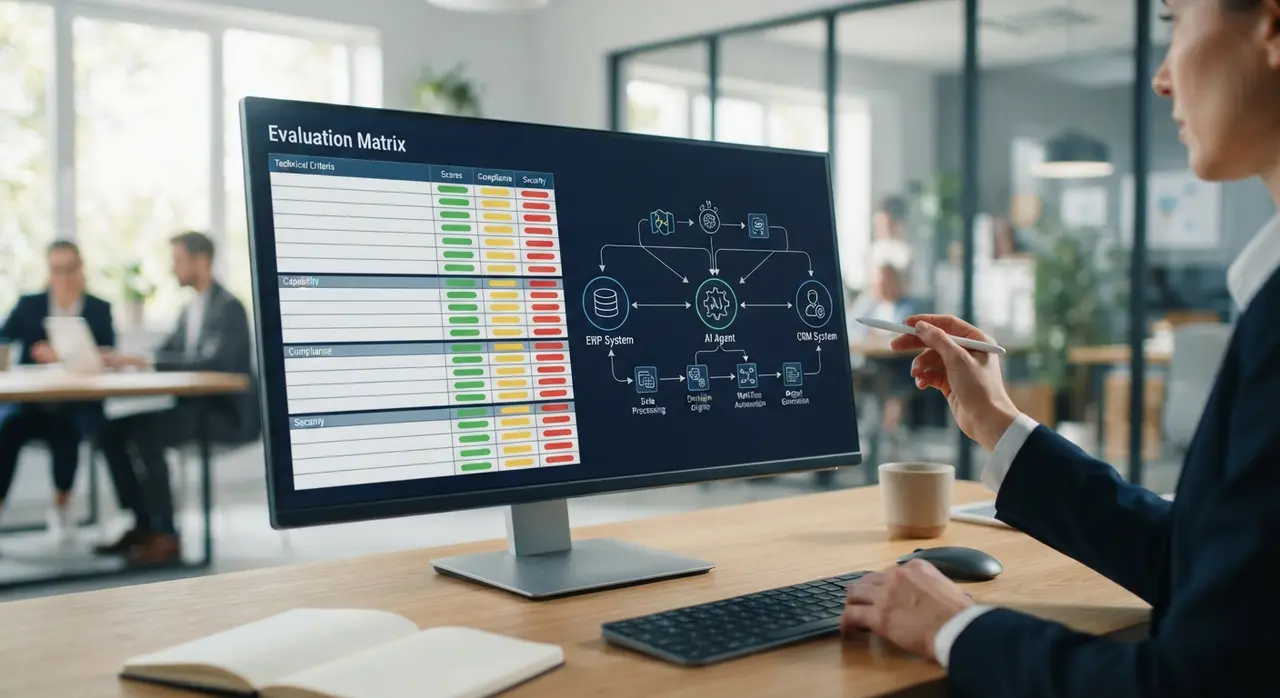
A structured scoring matrix ensures that technical capability, long-term support, and compliance weigh heavier than upfront price alone. Evaluating an intelligent agent vendor requires balancing immediate capability with long-term adaptability.
| Evaluation Criterion | Focus Area | Recommended Weight |
|---|---|---|
| Technical Architecture | Integration capability with existing CRM/ERP, execution speed, and fallback mechanisms | 30% |
| Governance & Security | Data encryption, compliance adherence, audit logging, and human override controls | 25% |
| Proven Experience | Verifiable case studies, industry track record, and operational metrics from similar deployments | 20% |
| Total Cost of Ownership (TCO) | Implementation fees, usage-based compute costs, maintenance SLAs, and scaling costs | 15% |
| Support & SLA Model | Post-implementation support, model retraining policies, and issue escalation workflows | 10% |
To guard your operations after vendor selection, establish strong service agreements by reviewing key AI automation SLA clauses prior to signing final contracts.
Mitigating Procurement Risk with a Paid Proof of Concept
A Proof of Concept (PoC) phase is the most reliable method to validate vendor claims before full-scale deployment. Incorporating a paid 30-day PoC into your RFP process allows vendors to prove their solution using actual company data in a controlled sandbox.
During the PoC, assess these practical dimensions:
- Accuracy & Exception Handling: How effectively does the agent process edge cases and trigger human intervention when confidence scores fall below thresholds?
- Latency & Integration Stability: Does the agent communicate seamlessly with your CRM and messaging APIs without system timeouts?
- User Adoption: Is the interface intuitive for operational teams who monitor agent actions?
By testing operational workflows early, enterprises avoid buying vaporware and gain clarity on real-world ROI.
Mini-Case: Standardizing Operations Across Multi-Unit Logistics
A regional logistics provider managing 14 distribution centers struggled with fragmented vendor proposals when automating delivery status updates and claims processing. Early bids ranged from simple chatbots to multi-million-dollar core infrastructure replacements.
To solve this, the company published an outcomes-focused RFP specifying WhatsApp integration, ERP data lookup, and human escalation rules. Partnering with Agentes Autônomos, they deployed tailored autonomous agent solutions that reduced customer wait times from 4 hours to under 2 minutes. The implementation preserved their legacy ERP, automated 78% of routine inquiries, and provided operational leads with a centralized human-in-the-loop dashboard.
Common RFP Pitfalls and How to Avoid Them
To structure a formal process that yields actionable proposals, enterprise teams must avoid three common mistakes:
- Over-specifying Technical Methods: Avoid dictating specific AI models or frameworks. State the operational outcome and let vendors propose the most resilient architecture.
- Selecting Based Solely on Upfront Price: Low initial deployment fees often mask high maintenance costs, token usage surcharges, or rigid change-request pricing.
- Neglecting Post-Launch Maintenance: AI systems require monitoring, prompt tuning, and API updates. Review clear AI agent support and maintenance protocols in every bid.
Conclusion
A structured RFP transforms AI procurement from a speculative gamble into a predictable strategic upgrade. By clearly defining operational constraints, requiring standardized cost models, and including a live PoC phase, business leaders can select the ideal vendor partner with confidence. Taking the time to build a thorough selection process guarantees scalable, secure, and high-ROI automation across your enterprise.
Frequently asked questions
What is an AI automation RFP?
An AI automation RFP is a formal procurement document that outlines an enterprise's technical, operational, and business requirements for hiring an AI vendor. It allows companies to systematically compare vendor solutions, integration capabilities, pricing structures, and governance models.
How long should an AI vendor selection process take?
A standard AI vendor selection process typically takes between 4 to 8 weeks from document publication to vendor selection. This timeline includes vendor proposal submission, technical scoring, shortlisted presentations, and a short Proof of Concept (PoC) phase.
Should an AI RFP specify exact AI models like GPT-4 or Claude?
No, an RFP should focus on desired operational outcomes, latency metrics, accuracy targets, and security compliance rather than locking in specific underlying models. Capable vendors will select or combine the best model architectures for your specific workflows and update them as technology evolves.