
AI Agent Integrated with SAP: How It Works in Practice
Learn how an AI Agent Integrated with SAP automates complex workflows in FI/CO, MM, and SD modules while maintaining strict governance and SOX compliance.
- SAP Integration
- AI Agents
- Enterprise Automation
- ERP Automation
- SOX Compliance

An AI Agent Integrated with SAP acts as an autonomous execution layer that reads, processes, and writes transactional data across ERP modules using secure native interfaces. How it works in practice for structured enterprise companies is by automating multi-step operations in Finance, Procurement, and Logistics without altering the underlying core SAP architecture.
Instead of relying on rigid, screen-scraping bots or heavy custom code, modern agentic AI systems interpret unstructured inputs—such as vendor invoices, incoming customer POs, and logistics updates—and execute standard SAP transactions directly through audited interface layers.
Understanding the SAP Ecosystem: Complexity, Control, and AI Integration
SAP environments demand zero-tolerance security, strict compliance, and flawless data governance during any automated execution. Structured organizations rely on SAP (whether S/4HANA or ECC) because it enforces standardized master data and strict transaction integrity across hundreds of operating units.
However, that same rigidity creates operational bottlenecks. Human specialists often spend thousands of hours transcribing data from email threads, supplier portals, and legacy PDFs into SAP screens. Replacing this manual effort requires an automation solution that deeply respects SAP’s role-based authorizations, locking mechanisms, and internal controls.
When deploying a practical solution for structured enterprise operations, autonomous agents do not replace SAP. They sit alongside SAP as digital teammates, taking over repetitive cognitive tasks while passing high-risk exceptions to human supervisors for approval.
High-Value SAP Modules for Autonomous AI Execution
Autonomous AI agents deliver the highest operational ROI when deployed across high-volume SAP modules like FI/CO, MM, and SD. These modules contain the core business cycles where delayed data entry directly impacts working capital and operational throughput.
By automating repetitive data validation and transaction creation within these modules, organizations maintain data purity while freeing domain experts for higher-value analytical work.
| SAP Module | Target Process | AI Agent Autonomous Role | Governance & Oversight |
|---|---|---|---|
| FI/CO (Finance & Controlling) | Accounts Payable & Reconciliation | Extracts invoice data, matches lines against Purchase Orders, posts preliminary park entries. | Human approval triggered if 3-way match variance exceeds configured tolerances. |
| MM (Materials Management) | Purchase Order Requisition & Vendor Quotes | Reads incoming supplier quotes, updates purchasing info records, and generates PRs/POs. | Requires manager sign-off on new supplier setup or POs above threshold. |
| SD (Sales & Distribution) | Customer Order Processing & Invoicing | Parses unstructured customer purchase orders from WhatsApp/Email and creates Sales Orders. | Automated check against credit limits; flags blocked customers for review. |
Architecture and Governance: How AI Interacts safely with SAP
Connecting an AI agent to SAP requires secure communication channels such as OData services and BAPIs combined with strict role-based authorization. Direct database writes are strictly forbidden in standard SAP governance due to the risk of corrupting relational tables and breaking auditability.
Modern agents communicate through SAP Gateway endpoints, RFC connections, or SAP Business Technology Platform (BTP) integration suites. The agent uses its own dedicated user credentials (SU01 service account) configured with granular authorization objects (PFCG roles).
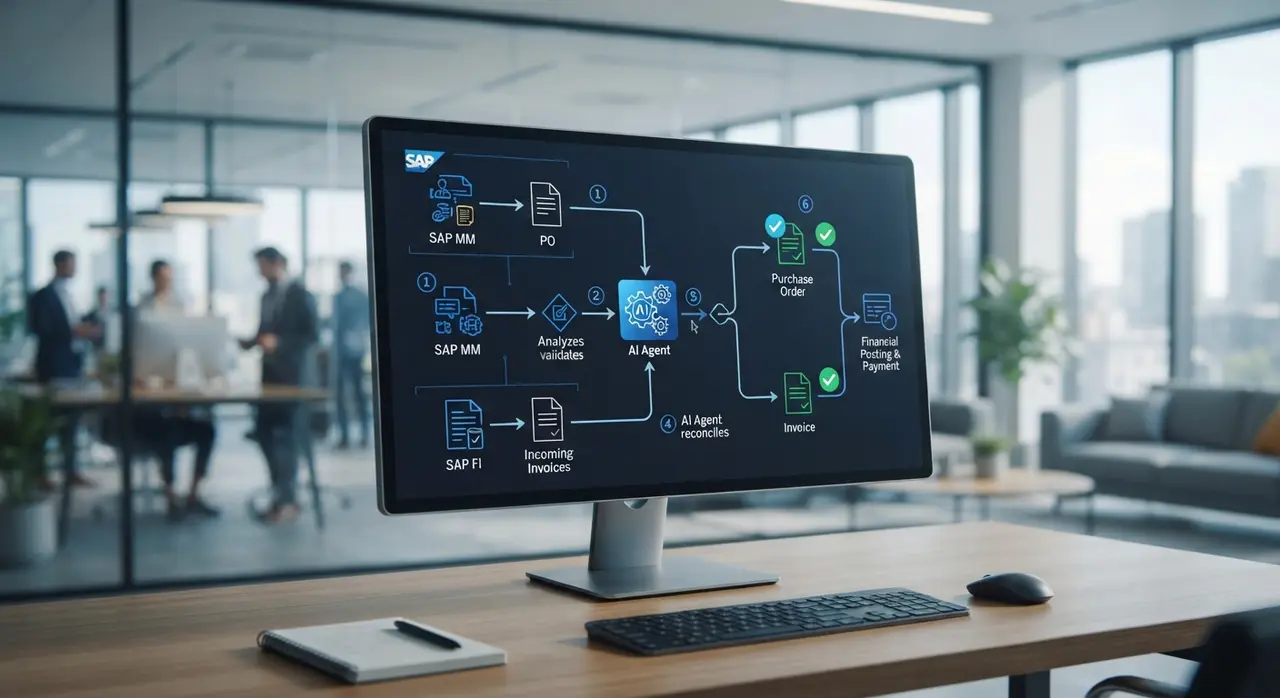
Every action taken by the agent is recorded under its dedicated user ID in standard SAP change logs (CDHDR/CDPOS tables). This architecture ensures that security teams retain complete visibility over who modified master records or created documents.
Maintaining Internal Controls and SOX Compliance
Enterprise compliance requires full audit trails for every automated read and write transaction performed within SAP core tables. For publicly traded companies or heavily regulated industries, introducing non-human agents into financial workflows triggers strict SOX (Sarbanes-Oxley) control evaluations.
To satisfy internal control teams, AI agents operate under a dual-layer validation model:
- Deterministic Business Rules: Hard rules defined in the agent's logic enforce SAP field requirements, approval limits, and Segregation of Duties (SoD).
- Human-in-the-Loop (HITL) Triggers: Any transaction involving missing tax codes, unrecognized vendors, or anomalous amounts is routed to a human interface before posting.
By enforcing clear fallback mechanisms and logging reasoning steps alongside transaction IDs, organizations can present fully compliant execution logs during internal and external audits.
Case Study: Streamlining High-Volume Accounts Payable in Manufacturing
A multi-plant industrial manufacturing group eliminated manual invoice matching backlogs by deploying SAP-integrated autonomous agents. The enterprise faced persistent delays in posting thousands of monthly vendor invoices into SAP FI, leading to missed early-payment discounts and stretched vendor relationships.
The company engaged Agentes Autônomos to deploy customized autonomous agent solutions that connected directly to their SAP ECC instance via standard BAPIs. The deployed agents continuously read inbound emails, ingested multi-page PDF invoices, matched line items against open Purchase Orders (MM-PO), and handled tax verification.
In less than 90 days, the organization achieved a 75% reduction in invoice processing lead time. Exception rates dropped significantly because the agents accurately flagged discrepancies before document parking, allowing human accounts payable specialists to focus solely on resolving complex vendor disputes.

Implementation Roadmap: Moving Safely from PoC to Production
Implementing enterprise AI within SAP requires a phased rollout starting with read-only validation before enabling full autonomous execution. Following a structured roadmap protects operational stability while allowing business units to measure real-world performance metrics.
- Process Scouting & Guardrails: Define high-volume, standard workflows. Check your criteria against an AI vendor evaluation checklist to verify compliance and API support.
- Read-Only Pilot (Shadow Mode): Deploy the agent to read SAP data, parse incoming inputs, and simulate transaction outputs without committing writes to the ERP.
- Controlled Write Mode (HITL): Enable the agent to create SAP draft documents (e.g., parked invoices or preliminary sales quotes) subject to 100% human sign-off.
- Full Autonomous Operation: Set confidence thresholds for automatic posting, routing only low-confidence exceptions to human operators.
Frequently asked questions
How does an AI agent connect to SAP without violating security?
An AI agent connects to SAP through standard, vendor-supported integration interfaces such as REST/OData APIs, RFCs, or SAP BTP connectors. It operates under a dedicated service account with specific, permissioned PFCG authorization roles, ensuring full alignment with enterprise security policies.
Can AI agents execute transactions directly in SAP S/4HANA and ECC?
Yes, AI agents can execute transactions in both SAP S/4HANA and SAP ECC systems by leveraging standard function modules and BAPIs. They perform operations like creating sales orders, parking invoices, or posting inventory movements while respecting system locks and validation rules.
How do AI agents handle exceptions or missing data in SAP workflows?
When an AI agent encounters missing data, structural errors, or validation mismatches, it routes the workflow to a human supervisor via a review dashboard. The human resolves the exception, and the agent completes the transaction based on the updated input.
Will integrating an AI agent affect our SAP licensing or compliance?
AI agent integrations comply with SAP indirect access policies when configured through official API channels and certified connectors. Assigning traceable service credentials ensures transparent usage tracking and full auditability for compliance reviews.