Open Source vs Proprietary AI Models: Enterprise Guide
Evaluating open source vs proprietary AI models requires balancing cost, security, and performance. Learn key advantages, risks, and decision criteria.
- Enterprise AI
- Open Source AI
- Proprietary AI
- AI Governance
- AI Architecture

Evaluating open source vs proprietary AI models requires balancing state-of-the-art reasoning capabilities against data governance, total cost of ownership, and long-term infrastructure control. Proprietary models offer immediate access to frontier intelligence via managed APIs, while open-source models provide total data sovereignty, deep customization, and predictable costs at scale.
For business owners and operations leaders scaling AI across sales, finance, customer support, and supply chain departments, choosing an architecture is a foundational decision. This guide breaks down the core trade-offs, practical operational risks, and key decision criteria needed to build a resilient, future-proof AI strategy.
Proprietary AI Models: Frontier Intelligence with External Dependencies
Proprietary AI models deliver state-of-the-art cognitive performance out of the box through vendor-managed APIs without requiring internal GPU hardware orchestration. Companies behind these commercial platforms invest billions of dollars in training massive parameter architectures, giving business users immediate access to advanced reasoning, multimodal processing, and complex document understanding.
Using commercial models via API allows teams to deploy intelligent workflows rapidly. Operations teams can integrate advanced language models into existing enterprise systems—such as ERPs, CRMs, and messaging channels—in days rather than months, avoiding hardware procurement delays and complex model hosting pipelines.
- Key Advantage: Instant access to cutting-edge model capabilities and regular background upgrades without internal maintenance.
- Key Advantage: Zero capital expenditure on hardware or dedicated AI DevOps teams during early rollout phases.
- Primary Risk: Variable pay-per-token costs that scale linearly with volume, creating budget unpredictability at massive operational scale.
- Primary Risk: Vendor lock-in, external data transit, and potential breaking changes in vendor pricing, deprecation schedules, or terms of service.
When implementing agentic AI systems that require sophisticated multi-step reasoning, proprietary models often provide the highest initial success rate for edge-case resolution.
Open-Source AI Models: Data Sovereignty and Customized Control
Open-source AI models grant organizations full visibility over weights, architectural customization, and data hosting environments, eliminating recurring third-party API token fees. By hosting models internally or within private cloud perimeters, enterprises ensure that sensitive corporate data, customer records, and trade secrets never leave their controlled environment.
Modern open weights models have narrowed the performance gap significantly for specific business tasks. When fine-tuned on company-specific datasets, lightweight open-source architectures can match or exceed generic commercial models on domain tasks like invoice classification, customer support ticket routing, or warehouse logistics management.
- Key Advantage: Complete data privacy and compliance control, satisfying strict regulatory mandates in finance, healthcare, and corporate governance.
- Key Advantage: Predictable infrastructure costs at high transaction volumes, as hosting costs relate to compute instances rather than token meters.
- Primary Risk: High technical debt if the organization lacks specialized talent to manage model serving, updates, and optimization pipelines.
- Primary Risk: Model capability lag compared to the absolute frontier of general-purpose commercial reasoning platforms.
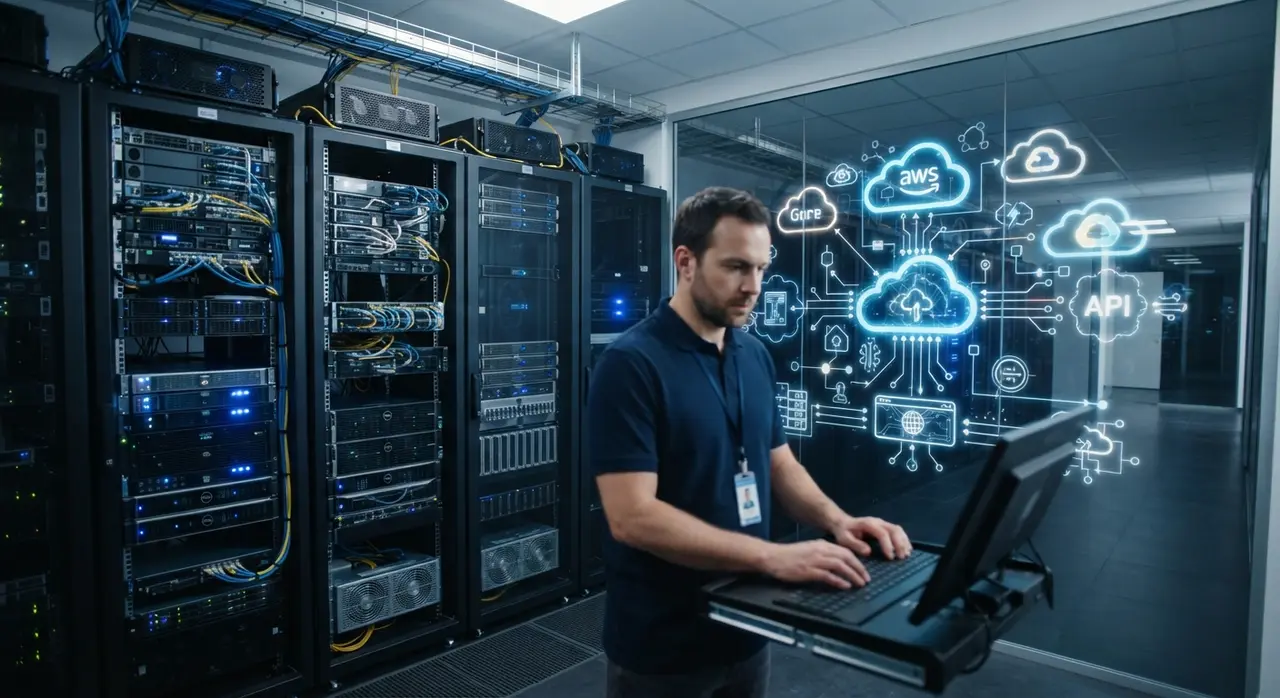
Comparing Enterprise AI Options: Advantages, Risks, and Decision Criteria
A structured evaluation matrix covering key advantages risks and decision criteria helps technical and business executives select the optimal foundation for every operational workflow within the organization.
| Evaluation Dimension | Proprietary AI Models (API) | Open-Source AI Models (Self-Hosted) |
|---|---|---|
| Data Privacy & Sovereignty | Data exits perimeter; requires strict enterprise privacy agreements. | Total sovereignty; data never leaves private enterprise cloud/on-prem. |
| Cost Structure | Variable operational expenditure based on token consumption volume. | Fixed infra compute costs; higher upfront deployment & DevOps investment. |
| Integration & Setup | Rapid deployment via standardized API endpoints into CRM/ERP. | Requires model deployment, container management, and hosting setups. |
| Customization Level | Prompt engineering, context retrieval (RAG), and fine-tuning APIs. | Full model fine-tuning, weight adjustments, and tailored parameter quantization. |
| Maintenance Effort | Vendor manages infrastructure, model security, and uptime SLAs. | Internal team handles hardware scaling, latency optimization, and updates. |
When selecting your operational stack, applying clear decision criteria prevents costly architectural overhauls after scaling. Evaluate every project based on regulatory constraints, transaction volume predictability, and required reasoning depth.
Architectural Strategy: Why Hybrid and Model-Agnostic Workflows Win
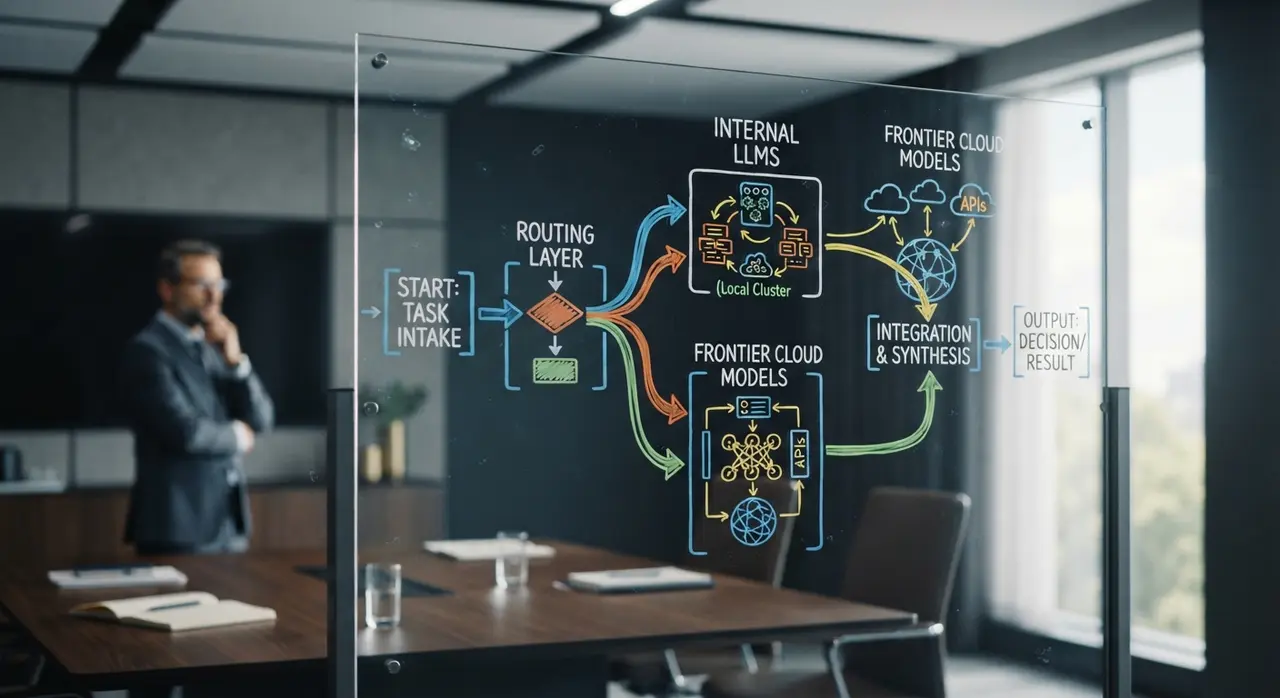
Model-agnostic orchestration enables enterprise architectures to route routine operational tasks to lightweight open-source models while directing complex executive reasoning to frontier proprietary APIs. Rather than forcing a single model paradigm across the whole company, successful deployments use an intelligent orchestration layer.
For instance, an enterprise automated workflow might process incoming WhatsApp messages and routine inventory lookups using a fast, self-hosted open-source model. If the customer request involves complex negotiation or contract reconciliation, the orchestrator seamlessly escalates the context to a high-reasoning proprietary model.
Real-World Scenario: Hybrid Deployment in Multi-Unit Operations
A multi-unit distribution company working with Agentes Autônomos implemented a model-agnostic architecture to automate order processing and vendor support. Routine document parsing and local inventory queries were assigned to fine-tuned, self-hosted open-source models, keeping operational data localized and cutting API costs by 45%. Meanwhile, exception handling and non-standard contract analysis were routed to proprietary commercial models, maintaining operational accuracy without overwhelming the internal infrastructure.
To ensure long-term flexibility, organizations should follow a structured AI vendor checklist to verify that integration middleware supports swift provider swapping without rewriting underlying process logic.
How Market Evolution Impacts Long-Term AI Decisions
The continuous velocity of AI development means that technical leads must avoid permanent technology lock-in. Models that represent state-of-the-art performance today will be surpassed or commoditized within twelve to eighteen months.
By adopting decoupled software architectures where model execution is insulated behind standardized internal interfaces, companies gain agility. This approach lets operations teams swap underlying open-source or proprietary models as pricing, speed, and cognitive capabilities change across the industry ecosystem.
Frequently asked questions
What is the primary financial difference between open-source and proprietary AI models?
Proprietary AI models charge on a variable pay-per-token API consumption structure, making initial entry cheap but high-volume scale expensive. Open-source models eliminate token costs in exchange for fixed infrastructure compute expenses and operational DevOps engineering talent.
How do data privacy requirements influence the decision criteria for enterprise AI?
Organizations operating under strict data privacy regulations or handling sensitive IP often prioritize self-hosted open-source models. Self-hosting guarantees that raw prompt data and company context remain completely within the private corporate network.
Can an enterprise combine both open-source and proprietary AI models in the same workflow?
Yes, adopting a hybrid architecture is recommended for enterprise deployments. This approach routes repetitive low-complexity tasks to self-hosted open-source models for cost efficiency while passing complex reasoning tasks to frontier proprietary models.
Does switching from a proprietary model to an open-source model require rebuilding business logic?
Not if your system is built on a model-agnostic architecture. Using abstracted integration layers allows businesses to swap the underlying language model without redesigning business rules, ERP connections, or frontend user interfaces.