How to Choose the Right ERP for AI Agent Integration
Learn how choosing the right ERP to integrate with AI agents avoids tech bottlenecks. Explore APIs, webhooks, data readiness, and legacy system bridges.
- ERP Integration
- AI Agents
- Enterprise AI
- Process Automation
- AI Governance
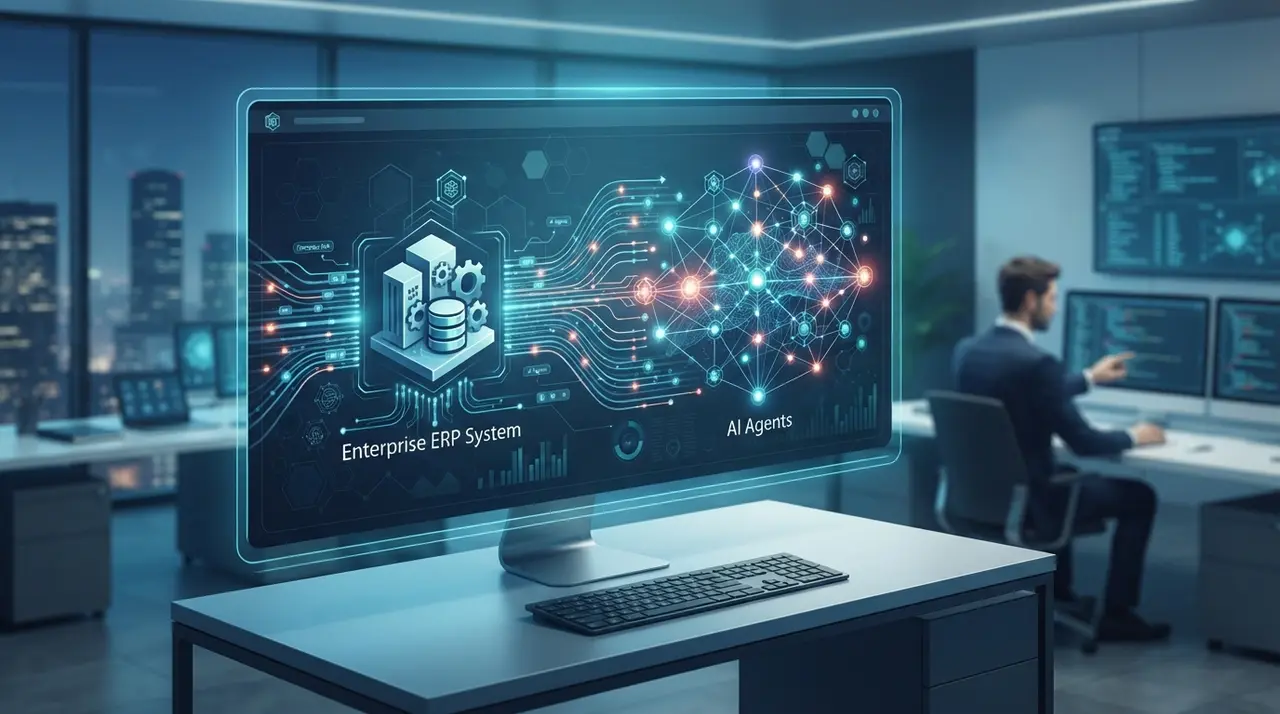
Choosing the right ERP to integrate with AI agents requires evaluating API accessibility, real-time webhooks, data structure, and granular permission controls. Selecting enterprise systems with open architectures prevents integration bottlenecks and avoids costly custom middleware rework.
As organizations scale autonomous operations, the underlying Enterprise Resource Planning (ERP) platform dictates the speed, reliability, and security of automated workflows. Business leaders often discover that technical criteria that prevent deployment failure must be evaluated long before writing a single line of automation code.
Why ERP Architectural Readiness Dictates AI Automation Success
An ERP architecture directly determines whether AI agents can read and write operational data in real time or remain trapped in manual data-entry siloes. When an enterprise system lacks native integration points, operational teams face persistent delays, sync errors, and unmanageable technical debt.
Integrating autonomous workers into core operations—such as supply chain management, financial reconciliation, or customer service—demands seamless interoperability. Systems like SAP, Oracle, TOTVS, Linx, and Microsoft Dynamics vary significantly in their openness. Choosing systems designed for cloud-native communication ensures your enterprise can unlock the full benefits of AI automation without replacing your core infrastructure.
Essential Technical Criteria That Prevent Integration Headaches
Modern enterprise integration relies on robust infrastructure standards that allow autonomous software agents to query databases, trigger business logic, and receive instant event notifications. Evaluating these parameters before deployment protects organizations from fragile, high-maintenance integrations.
Key technical capabilities fall into four primary categories:
- API Quality and Coverage: A comprehensive REST or GraphQL API exposes core business functions (orders, inventory, accounts payable) as structured endpoints rather than relying on raw SQL exports or batch CSV files.
- Real-Time Webhooks: Event-driven architecture ensures that when a new sales order or inventory alert occurs, the ERP proactively notifies the AI agent instantly without constant server polling.
- Data Accessibility and Schema Consistency: Well-documented data models allow AI models to accurately map fields across departments without complex string manipulation.
- Staging and Sandbox Environments: Dedicated test environments enable developers to safely validate AI actions before pushing updates to production databases.
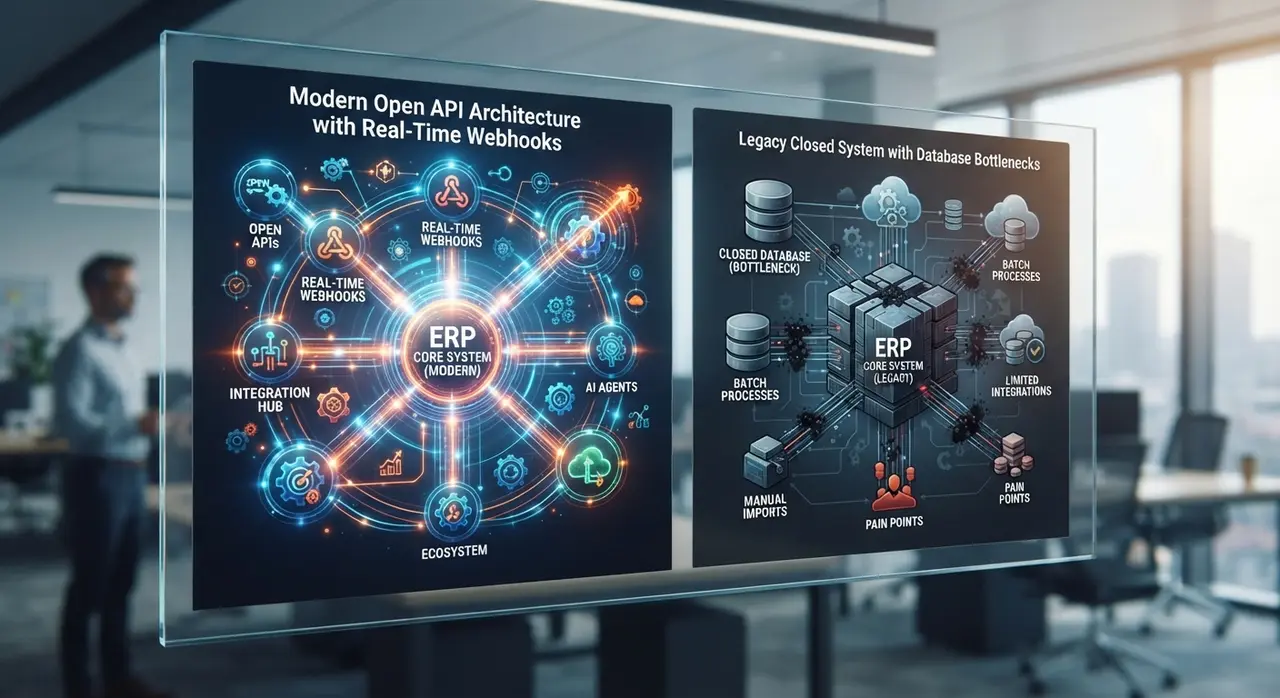
| Technical Criterion | Modern Open ERP Architecture | Legacy Closed ERP System | Impact on AI Agent Execution |
|---|---|---|---|
| API Protocol | RESTful / GraphQL APIs | SOAP, RPC, or flat file exports | Fast payload execution vs. slow, fragile batch processing. |
| Event Triggering | Native Webhooks (Real-Time) | Scheduled Polling / Cron jobs | Instant responses vs. delayed batch automation loops. |
| Permission Granularity | Role-Based Access Control (RBAC) | All-or-nothing admin keys | Secure operational boundaries vs. high security risks. |
| Testing Support | Isolated Sandbox / Staging | Production-only or shared DB | Safe validation vs. potential production data corruption. |
Navigating Legacy ERPs: RPAs, Middlewares, and Integration Layers
Legacy ERP systems without modern APIs require intermediate architectural layers to safely interface with autonomous AI agents. Replacing legacy core software is often cost-prohibitive, making integration bridges the most pragmatic path forward.
When dealing with legacy platforms, enterprise teams typically employ three structural workaround approaches:
- Robotic Process Automation (RPA) Bridges: Utilizing software robots to interact with legacy graphical user interfaces (GUIs), functioning as a visual API for the AI agent.
- Middleware & Enterprise Service Buses (ESB): Implementing platforms like MuleSoft, Dell Boomi, or custom microservices to translate legacy database queries into standardized REST JSON responses.
- Database Replication & CDC (Change Data Capture): Streaming database changes directly to a secondary read-only mirror, enabling AI agents to query records without stressing legacy server performance.
While legacy bridges require additional maintenance, they allow established enterprises to leverage advanced AI agent solutions without undertaking multi-year platform migration projects.
Enterprise Governance: Permissions, Auditing, and Human-in-the-Loop Controls
Robust governance frameworks prevent autonomous software agents from executing unverified financial transactions or corrupting master data. Establishing clear operational boundaries ensures compliance while maintaining organizational trust.
Security teams must enforce strict permission scoping. AI agents should operate under isolated service accounts configured with exact Role-Based Access Control (RBAC) permissions. For instance, a purchasing agent should hold write access only to draft purchase requisitions, while high-value purchase orders trigger a human review workflow before final posting.
Maintaining comprehensive audit logs inside the ERP allows management teams to review every action taken by an AI agent, including input payloads, confidence scores, and timestamps. Understanding how agentic AI differs from standard software helps teams establish appropriate oversight mechanisms across multi-unit operations.
Practical Case Study: Automating Order Processing Across Multi-Unit ERP Systems
Multi-unit operations often struggle with inconsistent data formatting when receiving orders across regional distribution hubs. A multi-national distributor running legacy ERP instances experienced severe order-entry backlogs and high error rates due to non-standardized client order forms.
The company partnered with Agentes Autônomos to deploy autonomous AI agents capable of extracting structured line-item data from inbound documents and validating product SKUs against master inventories. Instead of executing risky direct database writes, the agents were integrated via an API middleware layer with built-in human-in-the-loop review triggers for missing line items.
This hybrid operational model achieved an 85% reduction in manual order re-entry time while eliminating order fulfillment errors across seven regional hubs. Existing staff shifted their focus from manual typing to resolving high-value customer exceptions.

How Agentes Autônomos Evaluates ERP Readiness Before Automation
Agentes Autônomos performs a rigorous technical evaluation of enterprise ERP readiness before designing custom autonomous workflows. Conducting upfront technical diligence prevents project delays and protects existing IT infrastructure.
Our structured assessment covers five key operational dimensions:
- Endpoint Mapping: Verifying available API endpoints for key master data entities (customers, vendors, materials, ledgers).
- Throughput & Rate Limits: Testing server response limits to ensure AI query volume will not slow down business operations.
- Security & Authentication: Assessing support for OAuth 2.0, API keys, and enterprise SSO standards.
- Exception Handling: Reviewing error codes returned by the system to ensure agents can self-correct or route issues to human supervisors.
- Data Cleanliness: Analyzing database record consistency to minimize false positives during AI pattern matching.
For a detailed breakdown of partner selection and technical checklists, explore our AI agent vendor evaluation guide.
Conclusion
Choosing the right ERP to integrate with AI agents requires balancing technical criteria like REST APIs, real-time webhooks, and granular security controls. By systematically evaluating your current ERP capabilities—or establishing robust middleware bridges for legacy systems—your enterprise can eliminate operational rework, reduce manual processing queues, and scale AI-driven processes safely.
Frequently asked questions
Can AI agents integrate with legacy ERPs like older TOTVS or SAP releases?
Yes, AI agents can integrate with legacy ERP systems by utilizing API middleware, change data capture (CDC), or Robotic Process Automation (RPA) bridges. These intermediate technologies allow modern AI systems to read and write operational data safely without requiring direct modification of legacy core code.
What technical criteria prevent operational headaches during ERP integration?
Key technical criteria include comprehensive REST or GraphQL APIs, native webhook support for real-time events, granular role-based access control (RBAC), and isolated sandbox environments. Systems possessing these capabilities enable fast execution, robust security, and safe testing prior to production rollout.
How does human-in-the-loop validation protect ERP data integrity?
Human-in-the-loop workflows route low-confidence tasks or high-value transactions to human staff for approval before committing changes to the primary database. This hybrid governance model prevents erroneous database posts while training the AI system on edge-case exceptions.
Do we need to replace our existing ERP to deploy autonomous AI agents?
No, replacing your existing ERP is rarely necessary to implement autonomous AI workflows. Specialized AI integration partners can layer agentic capabilities over existing databases, CRMs, and ERP instances using secure API layers or custom middleware solutions.