
AI Agents for Industry: Pulp & Paper Automation
Discover how AI agents optimize continuous process automation in pulp and paper plants, cutting downtime, energy consumption, and quality variability.
- AI Agents for Industry
- Continuous Process Automation
- Pulp and Paper
- Large-Scale Operations
- Predictive Maintenance
- Process Control
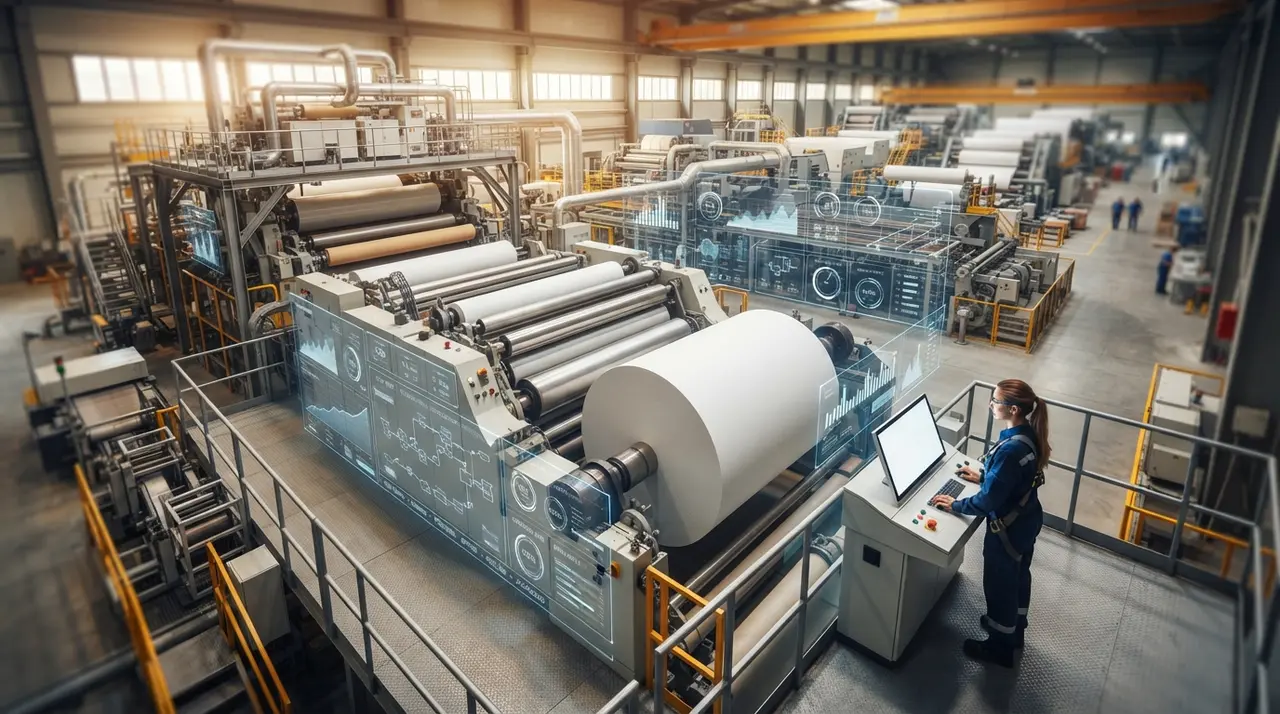
AI Agents for Industry enable dynamic monitoring and closed-loop control across Continuous Process Automation in Large-Scale Operations like pulp and paper mills. These intelligent software agents connect directly to legacy Distributed Control Systems (DCS), Programmable Logic Controllers (PLCs), and Enterprise Resource Planning (ERP) platforms to eliminate thermal drift, prevent unplanned outages, and maintain strict environmental compliance.
Pulp and paper manufacturing is one of the most capital-intensive and energy-demanding sectors in modern industry. Operating 24/7 continuous production lines means that a single unexpected failure in a recovery boiler or paper machine roll can cost hundreds of thousands of dollars per hour. Traditional Advanced Process Control (APC) systems rely on static mathematical models that struggle with natural raw material variability, such as wood chip moisture fluctuations and wood species blend shifts. Autonomous AI agents bridge this gap by acting as expert digital co-pilots that continuously analyze multi-variable telemetry and execute real-time operational adjustments.
Eliminating Unplanned Downtime in Pulp and Paper Manufacturing
Predictive maintenance powered by industrial AI agents reduces catastrophic equipment failures by continuously analyzing vibration, telemetry, and thermal patterns in critical assets like recovery boilers and paper machine rolls. Rather than relying on simple threshold alerts that trigger false positives, autonomous agents correlate acoustic signatures, bearing temperatures, motor currents, and lubrication pressures across thousands of historical sensor logs.
In continuous pulp digesters, liquor pressure anomalies often precede costly pipe plugging or shell erosion. AI agents detect micro-trends in differential pressure across liquor recirculation loops long before human operators notice thermal drift. By recommending or automatically initiating micro-adjustments in pump speeds and wash liquor flow rates, the system prevents scale buildup and maintains steady digester throughput.
For paper machine press and dryer sections, roll cover degradation directly impairs moisture removal efficiency. AI agents track minute roll vibration harmonics and load imbalances to predict exactly when a felt or doctor blade requires replacement. This allows mill managers to schedule targeted maintenance during planned stops rather than suffering emergency line shutdowns.
Continuous Quality Control and Automatic Parameter Tuning
Real-time quality control agents eliminate parameter drift by dynamically adjusting pulp consistency, basis weight, and moisture targets directly on the production line. Maintaining uniform sheet properties across high-speed paper machines requires balancing dozens of interacting variables simultaneously, including headbox pressure, wire drainage speed, steam pressure in dryer cans, and chemical additive dosing.
When wood chip pulp characteristics change, static control loops frequently overcompensate. This leads to out-of-spec reels suffering from uneven basis weight, strength loss, or moisture banding. AI agents utilize deep reinforcement learning and continuous sensor feeds to project how adjustments at the wet end will affect final reel quality twenty minutes later down the line.
| Operational Parameter | Traditional DCS / APC Approach | Autonomous AI Agent Approach |
|---|---|---|
| Wood Chip Moisture Variability | Manual lab testing every 2 to 4 hours with delayed setpoint changes. | Real-time continuous inference via inline NIR sensors and automated chemical/steam adjustments. |
| Basis Weight & Moisture Control | Reactive feedback loops adjusting steam after quality deviation occurs. | Predictive feedforward adjustments controlling headbox and dryer sections proactively. |
| Chemical Dosing (Bleaching) | Over-dosing chemicals to ensure brightness safety margins. | Dynamic optimization of chlorine dioxide and peroxide based on real-time kappa number targets. |
| Asset Fault Detection | Fixed threshold alarms triggering frequent alarm fatigue. | Multi-variable pattern recognition detecting subtle operational degradation weeks ahead. |
By constantly tweaking chemical bleaching feeds based on real-time kappa numbers, AI agents maintain brightness targets without wasting expensive bleaching agents. To see practical scenarios of how software agents execute automated control across industrial operations, explore our process automation examples.
Energy Optimization and Environmental Compliance
Energy management agents optimize steam generation and black liquor combustion to minimize fossil fuel usage while keeping stack emissions strictly within regulatory limits. Pulp mills are simultaneously massive energy consumers and energy producers through biomass recovery boilers. Managing the complex thermal balance between high-pressure steam generation, turbine extraction, and evaporators requires constant calculation.
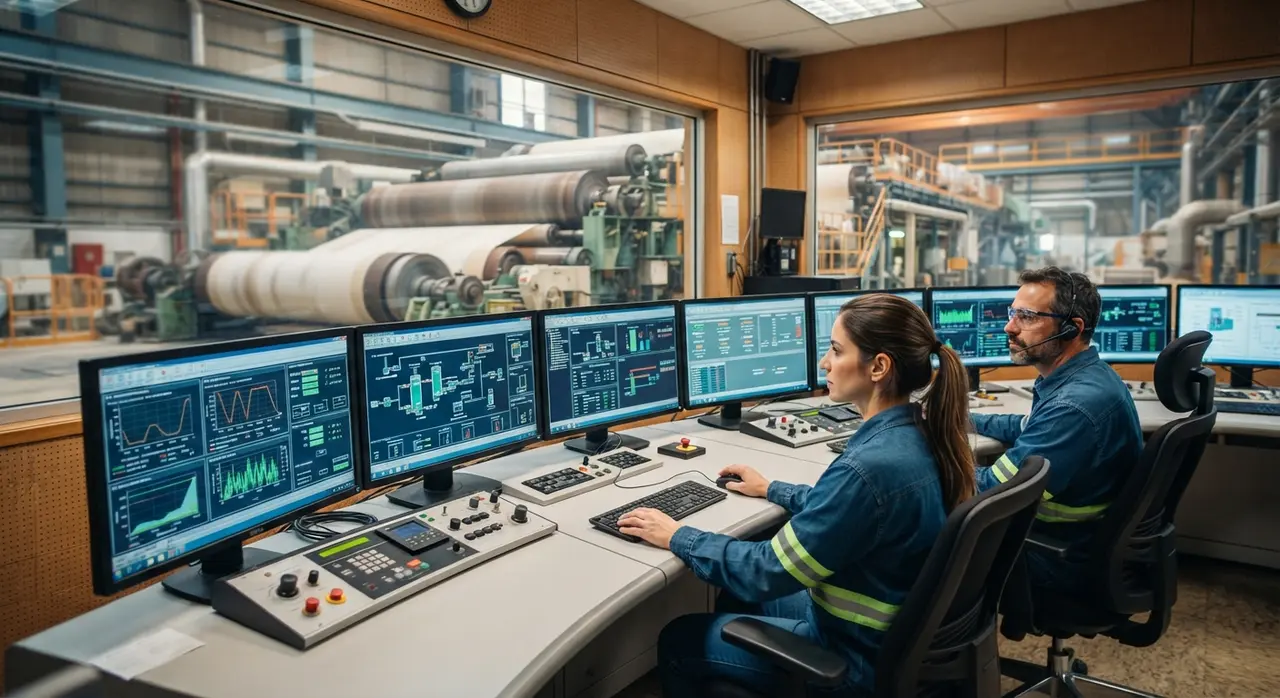
AI agents continuously evaluate steam header pressures, evaporator solid concentrations, and dryer section demand. When energy tariffs peak or biomass fuel moisture increases, the agent rebalances turbine extractions and boiler air ratios to maintain grid stability and lower auxiliary fuel consumption. This operational agility directly reduces the carbon footprint per ton of market pulp produced.
Environmental compliance for effluent treatment plants (ETP) and gas emissions is equally critical. Autonomous agents monitor chemical oxygen demand (COD), total suspended solids (TSS), and TRS gas emissions at discharge points. By predicting effluent load spikes hours before they reach aeration basins, the agent automatically regulates aeration blowers and chemical coagulants, ensuring regulatory compliance without human delay. To learn more about modern autonomous workflows, read about agentic AI capabilities in enterprise environments.
Full Process Traceability from Digester to Finished Reel
Production traceability agents cross-reference raw wood batch data with process variables and finished reel specifications to identify quality bottlenecks in real time. In a multi-stage mill, connecting raw wood chip origin to finished roll strength properties requires tracing material flow through digesters, oxygen delignification, washing, bleaching, and paper machine refining.
A major Latin American pulp manufacturer partnered with Agentes Autônomos to integrate AI agents with their existing OSIsoft PI system and SAP ERP. The operational challenge stemmed from sudden moisture variations in eucalyptus wood chips causing off-spec kraft paper reels during shift changes. By deploying specialized tracking agents to calculate liquor-to-wood ratios and adjust dryer steam profiles upstream, the plant reduced off-spec reel generation by 18% and reduced steam consumption per ton by 6% within 90 days.
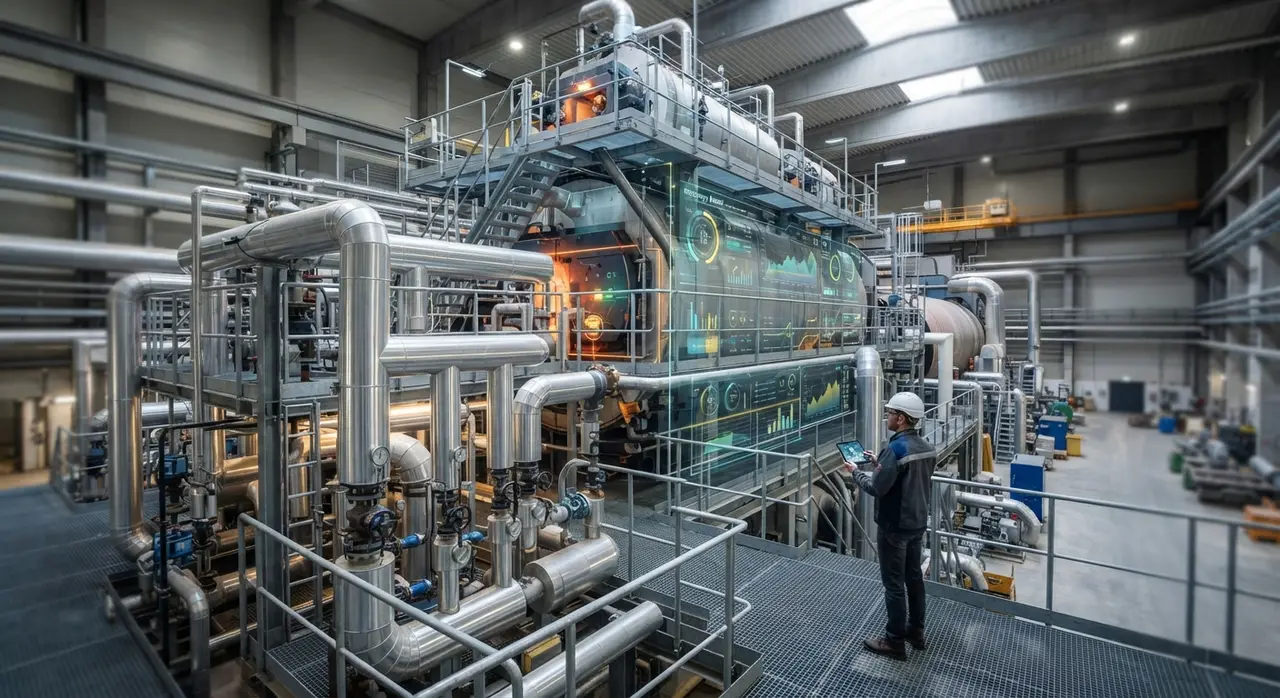
This automated traceability gives plant managers complete visibility across all production shifts. When a customer reports a roll quality defect, the AI agent immediately backtracks the exact cooking temp, liquor concentration, and refiner energy applied to that specific fiber batch, revealing root causes in minutes instead of weeks.
Governance and Human-in-the-Loop Supervision
Human-in-the-loop architecture guarantees operational safety by allowing plant engineers to review high-impact operational adjustments before autonomous execution. In heavy continuous manufacturing, safety and control system integrity are non-negotiable. AI agents do not bypass safety instrumented systems (SIS) or critical interlocks; instead, they operate within strict pre-approved operational envelopes set by chief engineers.
For routine micro-adjustments—such as fine-tuning basis weight valve positions by 0.5% or tweaking wash water flows—the agent acts autonomously within defined guardrails. However, for significant setpoint changes, such as modifying digester cooking temperature profiles or changing recovery boiler firing ratios, the agent generates an actionable recommendation sent directly to operator consoles or mobile dashboards via WhatsApp and web interfaces.
Operators can approve, modify, or reject recommendations with a single click. Every agent decision, sensor trigger, and operator response is logged in an immutable audit trail. This hybrid governance model yields all the efficiency of enterprise automation while keeping plant staff in complete control of production assets. Discover how this architecture drives enterprise efficiency by viewing our automation benefits guide.
Frequently asked questions
How do AI agents integrate with existing industrial DCS and SCADA systems?
AI agents integrate using standard industrial protocols such as OPC UA, MQTT, Modbus, and REST APIs, connecting directly to data historians like OSIsoft PI or Honeywell PHD. They read real-time telemetry from existing DCS and SCADA platforms without requiring replacement of legacy automation infrastructure. Recommendations or setpoint adjustments are sent back via secure, buffered industrial gateways.
Can AI agents reduce energy consumption in paper drying?
Yes, AI agents significantly reduce energy consumption by predicting moisture levels before paper enters the dryer section and adjusting steam pressure dynamically. By preventing over-drying and balancing headbox drainage, agents maintain target reel moisture while minimizing steam usage per ton of paper.
How does human oversight work in an automated continuous process?
Human oversight relies on guardrails and threshold-based approvals where engineers define permissible operation ranges for the AI agent. Routine micro-adjustments within safe ranges execute automatically, while high-impact changes trigger instant alerts on operator screens or mobile apps for one-click engineer approval.
What is the typical ROI timeframe for deploying AI agents in a pulp mill?
Most pulp and paper mills experience measurable return on investment within 3 to 6 months of agent deployment. Financial returns stem directly from reductions in unplanned downtime, lower chemical bleaching costs, reduced steam consumption, and a decrease in off-spec paper reels.