AI Agents for Healthcare Chains: Triage & Compliance
Deploy compliance-ready AI agents for hospital and lab networks. Streamline scheduling, triage, TISS billing, and HIS/LIS integration under CFM & ANVISA.
- AI Agents
- Healthcare Automation
- CFM and ANVISA
- Hospital Operations
- Patient Triage

Transforming Patient Flow: Intelligent Scheduling and No-Show Reduction
AI agents for healthcare networks orchestrate multi-unit patient scheduling, preliminary triage, and operational workflows while ensuring strict adherence to CFM and ANVISA regulatory frameworks. These autonomous digital workers integrate directly into existing Hospital Information Systems (HIS) and Laboratory Information Systems (LIS) to eliminate administrative bottlenecks, lower patient drop-off, and maintain uninterrupted clinical compliance.
Healthcare operational leaders face constant challenges with scheduling gaps, high no-show rates, and fragmented communications across multiple branches. Traditional call centers and basic chatbots often fail because they lack real-time context and deep system access. Intelligent AI agents for networks solve this by dynamically managing calendar slots across complex multi-unit networks.
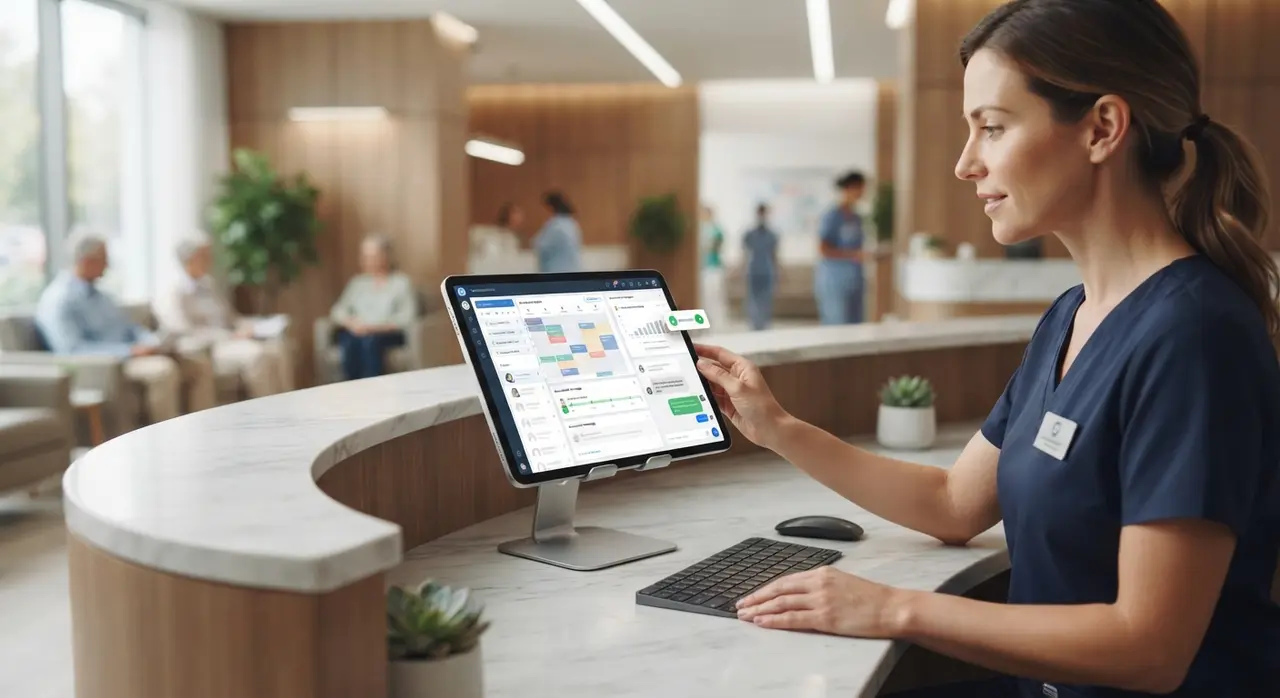
By connecting to WhatsApp, web portals, and internal systems, autonomous agents handle end-to-end appointment scheduling, pre-exam preparation instructions, and smart confirmation routines. When a patient requests an exam that requires specific fasting or preparation, the AI agent provides precise instructions, verifies understanding, and automatically reschedules slots if preparation conditions are not met.
- Dynamic Slot Optimization: Automatically fills canceled slots in real time by alerting waitlisted patients based on geographic preference and medical urgency.
- Interactive Pre-Exam Guidance: Delivers tailored preparation protocols (such as fasts, contrast requirements, or medication holds) directly through omnichannel messaging.
- Automated No-Show Mitigation: Conducts multi-step interactive confirmations, allowing instant rebooking if a patient cannot attend.
Patient Triage and Guidance: Clinical Support Without Crossing Regulatory Boundaries
Preliminary patient triage guided by autonomous agents streamlines access to care while adhering strictly to ethical boundaries. The AI agent gathers initial symptom reports, categorizes patient needs using standardized protocols, and directs individuals to the appropriate point of care—whether that is an urgent care unit, an outpatient clinic, or a specialized diagnostic lab.
Crucially, autonomous AI agents operate under defined rule boundaries: they support operational navigation and clinical routing without issuing medical diagnoses or therapeutic plans. By integrating with electronic medical records (PEP/EMR), the agent records every patient interaction, giving triage nurses and attending physicians immediate visibility into pre-consultation details.
This structured intake reduces waiting room congestion, minimizes misrouted appointments, and ensures high-acuity patients receive immediate priority attention. For multi-unit networks, this capability balances operational load across geographically distributed facilities, optimizing staff utilization.
Administrative Automation: Health Plan Authorizations and TISS Billing
Administrative overhead in Brazilian healthcare networks frequently causes revenue cycle delays and patient frustration. AI agents automate complex back-office workflows, including health insurance eligibility verification, pre-authorization requests, and TISS (Troca de Informação em Saúde Suplementar) billing validation.
Unlike rigid traditional software, AI agents read medical requests, extract required clinical justification codes, cross-reference coverage rules across multiple health plans, and submit authorization documentation autonomously. When a request requires manual clinical review, the agent flags the file and routes it directly to the medical audit team with all necessary documentation attached.
This intelligent execution eliminates repetitive manual data entry, drastically reduces claim denials (glosas), and accelerates payment cycles across all units. To understand how agentic decision-making surpasses static legacy scripts, explore the key operational differences in AI agents vs RPA for enterprise workflows.
System Integration and Data Traceability across HIS, LIS, and RIS
Enterprise healthcare networks operate on deep technical stacks involving HIS (such as MV, TASY, or Pixeon), LIS (Laboratory Information Systems), and RIS (Radiology Information Systems). AI agents interface directly with these core platforms using secure APIs or database connectors, eliminating the need to replace existing core infrastructure.
ANVISA and ANPD compliance requirements mandate absolute auditability for every data transaction involving sensitive health records. Autonomous agents generate immutable audit logs for every system action, tracking data queries, pre-authorization submissions, and patient communication history down to the precise timestamp.
- Bi-Directional EMR Synchronization: Ensures patient status, exam results, and consultation records are updated instantaneously across all network branches.
- ANVISA-Grade Traceability: Tracks every digital action with full audit trails, logging data access, approval events, and user context.
- Seamless Interoperability: Connects disparate legacy platforms without requiring disruptive, high-risk core system migration projects.
Comparative Analysis: Legacy Workflows vs. Autonomous AI Agent Orchestration
Modernizing operational workflows requires evaluating performance across efficiency, regulatory compliance, and system integration. The table below illustrates the operational impact of moving from legacy manual processes to AI agent orchestration across hospital and lab networks.
| Operational Dimension | Legacy Manual / Basic Automation | Autonomous AI Agent Orchestration |
|---|---|---|
| Appointment Scheduling | High agent call times, manual slot assignment, elevated no-show rates. | Real-time omnichannel scheduling, dynamic slot filling, automated preparation tracking. |
| Initial Triage & Routing | Generic web forms, manual phone screening, frequent misrouting to ER. | Protocol-based initial routing, immediate urgency scoring, direct EMR integration. |
| TISS Billing & Authorizations | Manual document verification, high claim denial rates, delayed pre-authorizations. | Automated coverage extraction, instant TISS validation, intelligent exception routing. |
| Regulatory Compliance | Fragmented manual logs, risk of human error in LGPD/CFM compliance. | Automated audit trails, strict rule boundaries, deterministic data handling under CFM & ANVISA. |
| System Integration | Isolated silos requiring manual double-entry across HIS/LIS. | Unified orchestration layers connecting HIS, LIS, RIS, and CRM seamlessly. |

Regulatory Governance: CFM, ANVISA, and LGPD Compliance in Action
Regulatory compliance in healthcare is non-negotiable. The Federal Council of Medicine (CFM) dictates strict guidelines regarding artificial intelligence: AI systems must function strictly as supportive tools for administrative and operational efficiency, never usurping clinical autonomy or rendering final autonomous medical diagnoses.
From a data privacy perspective under LGPD (Lei Geral de Proteção de Dados), patient health records qualify as sensitive personal data requiring enhanced encryption, strict access controls, and transparent consent management. AI agents operate within secure enterprise boundaries, utilizing encrypted communication channels and anonymized data pipelines during processing.
Furthermore, ANVISA requirements for health software demand strict quality management, system verification, and risk mitigation. Integrating continuous governance controls ensures that human-in-the-loop (HITL) safeguards trigger whenever an action exceeds predefined risk parameters. Enterprise leaders can review detailed frameworks for mapping operational security in our guide on AI automation diagnosis and risk mapping.
Real-World Implementation: Mini Case Study in a Multi-Unit Diagnostic Network
A leading Brazilian diagnostic network operating 24 laboratory units across three metropolitan areas faced severe operational friction: call center wait times averaged over 6 minutes, exam preparation errors caused a 14% appointment cancellation rate at reception, and TISS authorization rejections reached 8% monthly.
Partnering with Agentes Autômomos, the network deployed tailored AI agents integrated directly into their LIS and WhatsApp channels. The agents took over scheduling inquiries, validated insurance eligibility prior to booking, and executed interactive preparation reminders 48 and 24 hours before complex exams.
Within 90 days of deployment, the network achieved remarkable operational gains without changing their core LIS software:
- No-Show Reduction: Appointment drop-offs fell by 38% due to interactive preparation confirmation.
- TISS Claim Denials: Authorization errors dropped to under 1.2% through automated pre-validation.
- Call Center Relief: Over 62% of routine scheduling and exam status inquiries were handled autonomously without human intervention.
- Full CFM/ANVISA Compliance: Zero regulatory flags, supported by comprehensive system logging and zero clinical scope creep.
Frequently asked questions
How do AI agents ensure compliance with CFM guidelines on clinical decisions?
AI agents are programmed with strict operational boundaries that restrict them to administrative, navigational, and preliminary triage workflows. They do not issue medical diagnoses, prescribe treatments, or alter clinical orders, ensuring full compliance with CFM directives that preserve medical decision-making strictly for licensed physicians.
Can AI agents integrate with legacy HIS and LIS software without replacing infrastructure?
Yes, AI agents integrate directly with existing HIS, LIS, and RIS platforms through standard APIs, database layers, or secure automation protocols. This allows hospital networks to modernize scheduling, TISS billing, and triage without undertaking costly and risky core system replacements.
How does the AI agent handle sensitive patient health data under LGPD?
AI agents process patient data using end-to-end encryption, role-based access control, and strict data minimization techniques required for sensitive health information under LGPD. Every transaction generates an audit trail, ensuring complete data governance and regulatory accountability across all digital touchpoints.