AI Agents in Chemical Industry: Process & Maintenance
Discover how AI agents for the chemical industry optimize continuous process monitoring, prevent downtime, and automate predictive maintenance safely.
- Chemical Industry
- Predictive Maintenance
- Continuous Process Monitoring
- AI Agents
- Industrial Automation
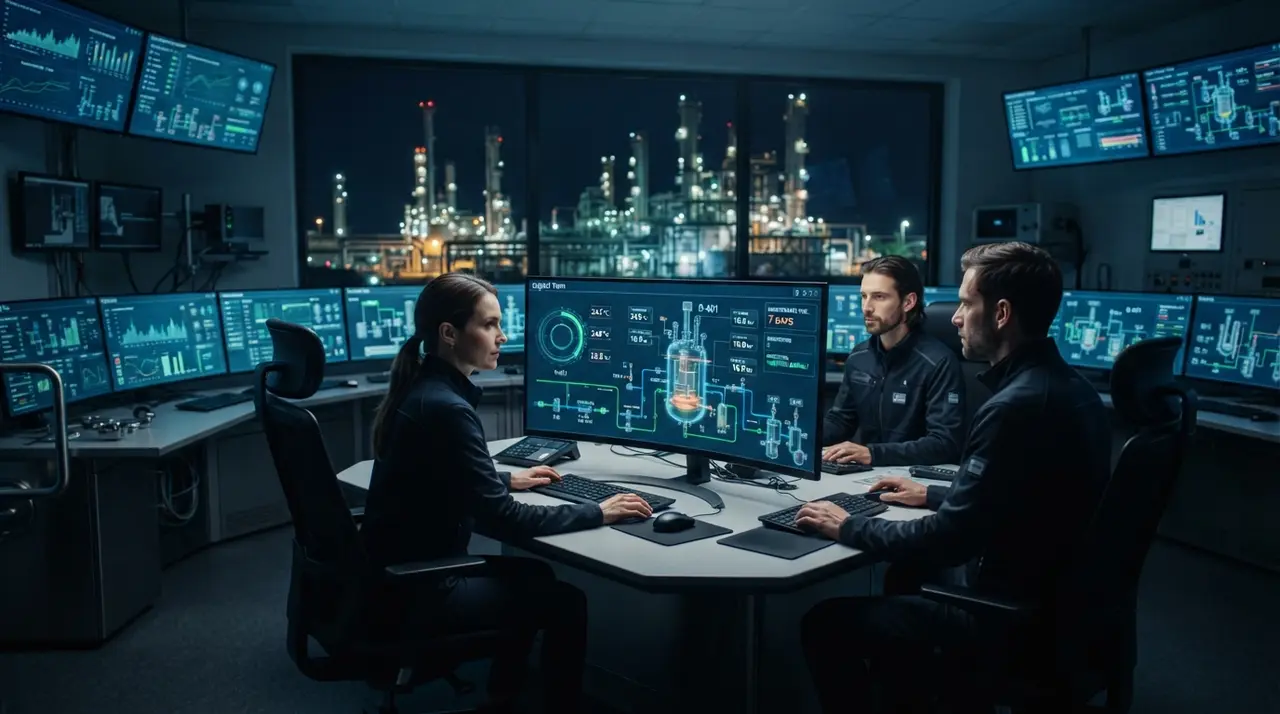
Deploying AI agents for the chemical industry enables real-time continuous process monitoring and automated predictive maintenance across complex refining and synthesis operations. These autonomous systems continuously analyze operational variables—such as pressure, temperature, and fluid dynamics—to prevent unplanned downtime and enforce stringent safety standards.
In high-risk continuous processing environments, even a minor drift in operational parameters can cause off-spec production batches, costly equipment damage, or severe environmental compliance violations. Traditional Distributed Control Systems (DCS) excel at deterministic control, but struggle to detect subtle, multi-variable correlations that precede catastrophic equipment failure or thermal runaway events.
By integrating intelligent agentic workflows into existing plant infrastructure, chemical and petrochemical manufacturers gain proactive operational governance without replacing legacy systems or compromising process safety margins.
Continuous Process Monitoring Eliminates Operational Drift
Continuous process monitoring using specialized AI agents transforms raw sensor feeds into actionable operational oversight by evaluating complex variable interactions concurrently. Chemical synthesis processes rely on delicate equilibriums where temperature, pressure, flow rate, and catalyst purity directly impact product yield and safety.
Rather than monitoring individual parameters against static high/low thresholds, autonomous agents establish a holistic multi-dimensional baseline for normal operating conditions. When operating variables begin drifting in combinations that signal impending instability, the AI agent highlights the root cause and calculates optimal setpoint adjustments before automated safety interlocks trip the plant.
- Multi-variable pattern recognition: Identifies subtle thermodynamic shifts across interconnected processing units.
- Early anomaly detection: Flags deviations hours before traditional alarm thresholds are breached.
- Yield and spec optimization: Recommends real-time feed-rate adjustments to keep chemical purity within narrow target tolerances.
By leveraging autonomous agentic AI, operations teams move from reactive troubleshooting to continuous, autonomous optimization of every processing stage.
Predictive Maintenance Protects Critical Heavy Assets
Predictive maintenance powered by AI agents prevents severe mechanical failures in critical rotating and thermal equipment across chemical facilities. Equipment such as multi-stage centrifugal compressors, high-pressure reactor vessels, boiler feed pumps, and shell-and-tube heat exchangers operate under aggressive thermal and chemical stress.
Conventional maintenance regimes rely either on fixed run-time schedules or isolated vibration checks. In contrast, AI agents continuously ingest vibration spectra, bearing temperatures, lubricant degradation markers, and differential pressure data from plant historians to calculate precise Remaining Useful Life (RUL) estimates for each asset.
When anomalous wear patterns emerge, the agent automatically drafts a prioritized maintenance work order, identifies required spare parts in the ERP, and flags the optimal maintenance window to prevent unbudgeted production line halts.
Integrating AI Agents with DCS, SCADA, and Process Historians
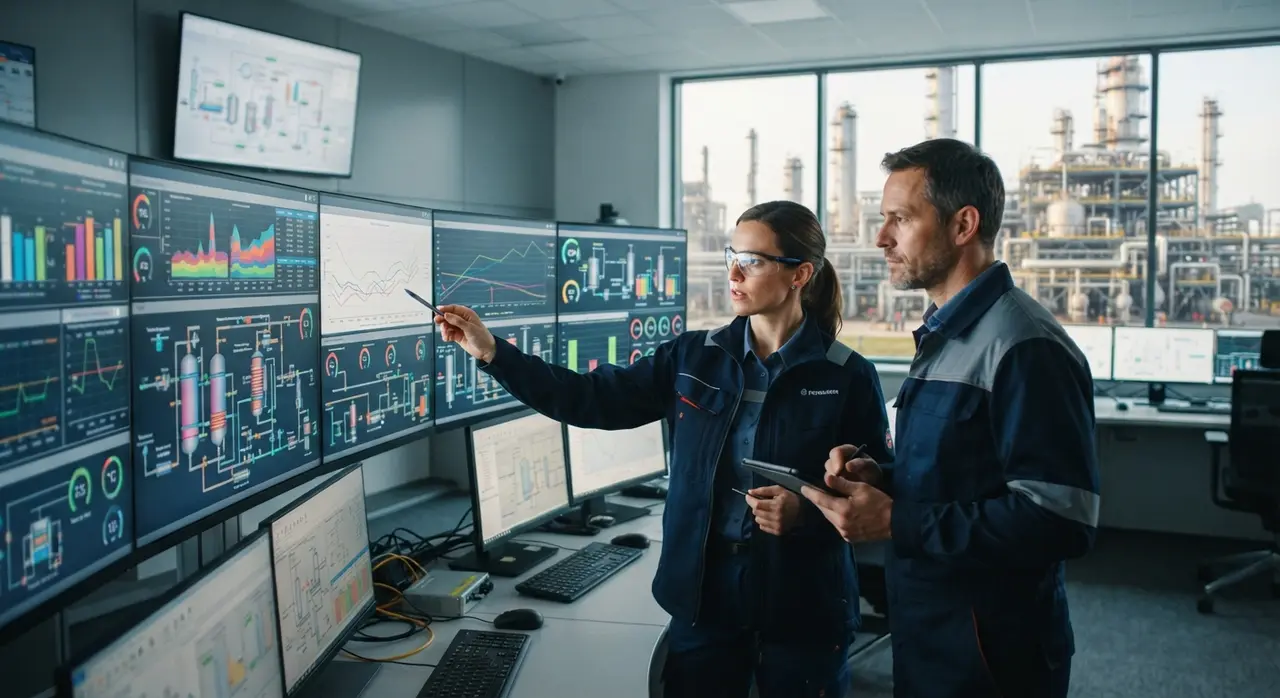
Integrating AI agents with enterprise DCS, SCADA, and data historians allows chemical plants to modernise operational intelligence without disturbing certified control logic. Chemical plants cannot afford to replace existing Honeywell Experion, Emerson DeltaV, or ABB System 800xA control systems due to high capital expenditures and strict regulatory re-validation requirements.
AI agents act as an intelligent orchestration layer directly above enterprise data historians (such as AVEVA PI System or Honeywell PHD). They communicate via secure industrial protocols like OPC UA and MQTT, reading historical and real-time telemetry while operating within safe, strictly defined human-in-the-loop guardrails.
| Operational Capability | Traditional DCS / SCADA Control | AI Agent Orchestration Layer |
|---|---|---|
| Data Analysis Scope | Single-variable threshold alerts and localized loops | Multi-variable historical correlation across entire plant |
| Maintenance Approach | Reactive alarms and calendar-based preventive schedules | Predictive, sensor-driven RUL forecasting and auto-workorders |
| Energy & Feedstock Tuning | Static setpoints set manually by operators per shift | Dynamic continuous optimization based on real-time cost & purity |
| Safety & Alarm Management | Prone to alarm fatigue during operational upsets | Intelligent root-cause isolation and contextual guidance |
| Integration Overhead | High capital cost to upgrade hardware PLC/DCS controllers | Non-intrusive software deployment over existing OPC UA historians |
This hybrid architecture ensures that plant safety instrumented systems (SIS) retain ultimate trip control, while AI agents deliver strategic insight and automated workflow execution to plant engineers.
Safety, Environmental Compliance, and Emission Monitoring
Autonomous AI agents strengthen safety compliance and environmental monitoring by enforcing automated checks on continuous flare stacks, wastewater treatment outputs, and volatile organic compound (VOC) emissions. Regulatory frameworks require strict compliance reporting and zero tolerance for toxic chemical leaks or flaring excessive unreacted hydrocarbons.
AI agents analyze upstream gas compositions and combustion parameters to optimize flare destruction efficiency and reduce greenhouse gas releases. Furthermore, if a valve seal or pump packing begins leaking fugitive emissions, the system cross-references ambient air sensors with localized pressure losses to pinpoint the exact leak location immediately.
Automating these compliance workflows reduces regulatory liability and delivers accurate, auditable audit trails required by environmental enforcement agencies worldwide.
Mini-Case: Petrochemical Catalyst Protection and Downtime Reduction
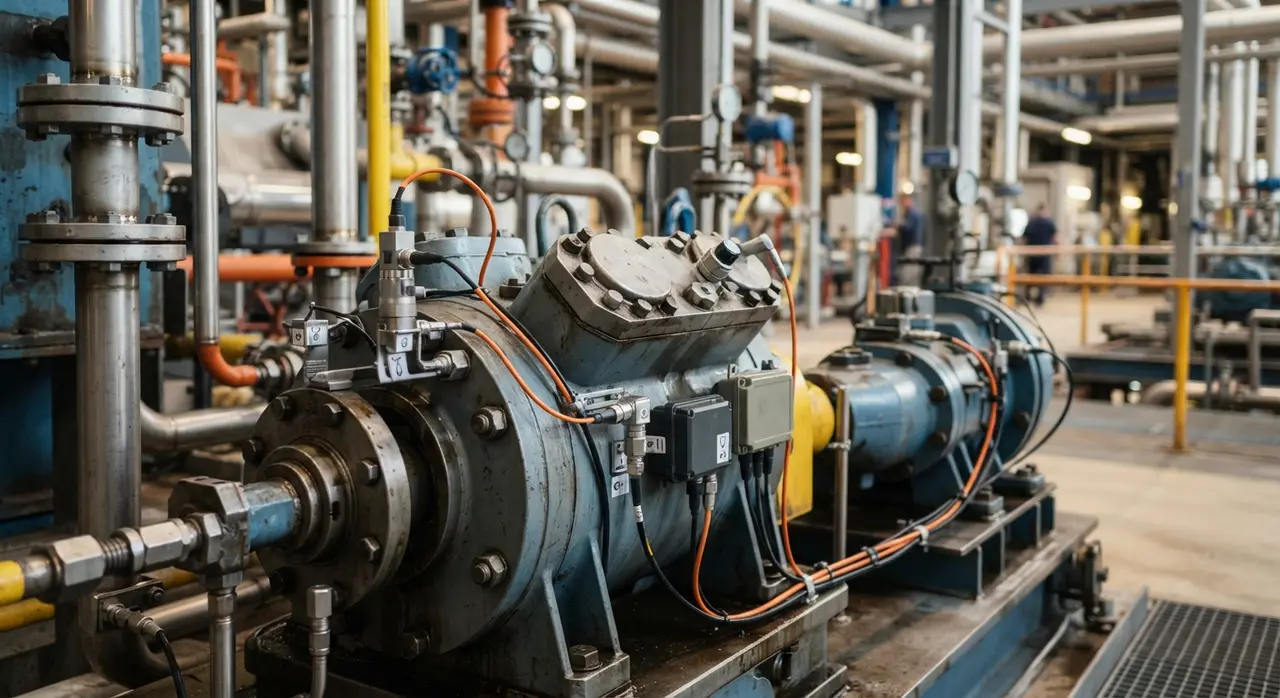
A regional petro-chemical synthesis facility faced recurring, unexpected catalyst poisoning events and unplanned compressor trips that cost significant production losses per occurrence. The facility utilized standard SCADA alarms, but operators frequently missed early micro-fluctuations in feedstock composition and bearing temperature spikes during shift transitions.
By implementing targeted tailored AI agent solutions from Agentes Autônomos, connected directly to their AVEVA PI historian, the plant established automated continuous process monitoring across its hydrocracking unit. The AI agents monitored catalyst bed differential pressures alongside feed moisture levels in real time.
Within six months of deployment, the facility achieved clear qualitative and quantitative operational gains:
- Zero unplanned compressor trips: Predictive diagnostics caught bearing lubrication failure 72 hours before catastrophic damage occurred.
- Extended catalyst lifecycle: Real-time feed composition adjustments prevented thermal spiking and prolonged catalyst activity by over 18%.
- Eliminated operator alarm fatigue: Intelligent filtering suppressed redundant cascade alarms during start-up cycles, presenting clear root-cause guidance instead.
By leveraging the operational benefits of industrial AI, the plant secured higher daily yield while lowering total maintenance expenditure.
Implementation Roadmap for Chemical Operations Managers
Successfully implementing AI agents in a continuous processing plant requires a structured execution framework that prioritizes safety, data integrity, and operational acceptance. Managers should follow a four-phase strategy:
- Data Infrastructure Audit: Verify that OT historians, OPC UA servers, and asset tag naming conventions are standardized and accessible.
- High-Value Pilot Selection: Identify a critical asset group (e.g., primary refrigeration compressors or high-temperature reactors) with historical failure data to quantify initial ROI.
- Human-in-the-Loop Validation: Configure AI agents to generate recommendations and work orders that require explicit approval from plant engineers before closed-loop adjustments.
- Plant-Wide Scaling: Expand agent coverage to energy management, feedstock optimization, and automated environmental reporting across all operating units.
Conclusion
Deploying AI agents for continuous process monitoring and predictive maintenance empowers chemical and petrochemical companies to maximize production availability, protect physical assets, and eliminate preventable safety hazards. By augmenting existing DCS and SCADA investments with autonomous software intelligence, operations leaders can maintain strict process control while reducing operational costs and driving environmental sustainability.
Frequently asked questions
How do AI agents integrate with existing DCS and SCADA systems without risking plant safety?
AI agents integrate as a non-intrusive software layer via industrial data historians and read-only OPC UA or MQTT connections. They do not overwrite certified Safety Instrumented Systems (SIS) logic. Recommendations or setpoint tweaks are presented to human operators or routed through strict validation guardrails before execution.
What is the difference between traditional preventive maintenance and AI-driven predictive maintenance?
Traditional preventive maintenance follows fixed calendar schedules or engine operating hours regardless of actual asset health. AI-driven predictive maintenance continuously analyzes real-time sensor streams—such as vibration analysis, thermal telemetry, and fluid pressures—to predict exact component wear and schedule repairs only when necessary before failure occurs.
Can AI agents help chemical plants meet strict environmental and safety regulations?
Yes, AI agents continuously track stack emissions, fugitive VOC leaks, and effluent water parameters against regulatory limits in real time. They automatically flag early leak indicators, optimize combustion efficiency in flare systems, and build automated, audit-ready compliance reports for environmental agencies.