Agentic AI: What It Is and How It Differs
Discover how agentic AI plans, executes, and self-corrects enterprise workflows beyond generative AI and chatbots to drive real operational efficiency.
- Agentic AI
- Enterprise AI
- Generative AI
- Process Automation
- AI Governance

Agentic AI is an advanced paradigm in enterprise technology where artificial intelligence systems autonomously plan, reason, use external tools, and execute multi-step workflows to achieve complex operational goals. Unlike static automation or simple conversational models, agentic systems continuously perceive their environment, adjust their strategy, and execute real-world actions across databases, ERPs, and CRMs.
As enterprise leaders scale digital transformation across sales, operations, customer support, and finance, understanding this shift is essential. While early automation solved repetitive task execution, Agentic AI addresses complex problem-solving that previously required constant human oversight.
What Is Agentic AI and How It Executes Business Operations
Agentic AI represents a functional evolution from content generation to task execution within enterprise environments. Instead of relying on rigid, pre-written decision trees, an agentic system breaks down broad business objectives into discrete, executable steps.
When assigned a high-level goal—such as resolving a complex supply chain discrepancy—the agent evaluates available data, selects necessary enterprise tools, performs actions via APIs, and validates the output. If an action fails, the agent re-evaluates the failure and attempts an alternative approach without crashing the workflow.
Key characteristics that define an agentic architecture include:
- Goal Decomposition: Breaking down multi-tiered directives into structured actionable tasks.
- Tool Integration: Querying databases, issuing API calls, and interacting directly with legacy ERPs or CRMs through function calling capabilities.
- Self-Correction: Detecting execution errors, rerouting tasks, and refining queries dynamically.
- Persistent Context: Maintaining state across long operational cycles to ensure enterprise consistency.
Agentic AI vs Traditional Automation, Chatbots, and Generative AI
Enterprise technology teams frequently group modern software into broad AI categories, leading to confusion during vendor selection and architecture planning. Distinguishing between traditional automation, conversational chatbots, generative models, and agentic systems is critical for establishing clear operational boundaries and realistic ROI expectations.
| Technology Type | Primary Logic | Action Autonomy | Adaptability | Enterprise Use Case |
|---|---|---|---|---|
| Traditional Automation (RPA) | Fixed rules (If-Then) | Executes script without deviation | Zero (breaks if UI/data shifts) | Data entry, scheduled report generation |
| Chatbots | Pattern matching / Scripted intent | Answers queries, minimal action | Low (bound to fixed intent flows) | Basic FAQ response, basic routing |
| Generative AI | Probabilistic text/media generation | Produces output on prompt demand | High in text, zero native action | ['] Drafting copy, summarizing documents|
| Agentic AI | Perceive-Reason-Act decision cycle | Plans, executes tools, self-corrects | High (adapts execution steps dynamically) | End-to-end process resolution, multi-unit operations |
Traditional rule-based automation performs predictable tasks exceptionally well, but fails when faced with edge cases or unformatted input. Chatbots provide basic customer routing but lack backend authority to resolve operational issues independently.
Generative AI tools excel at drafting documents or analyzing sentiment, yet they remain passive observers unless wrapped in an execution layer. Agentic AI combines reasoning with execution, bridging the gap between insight generation and tangible operational results.
How Agentic Systems Work: The Perceive-Reason-Act Loop
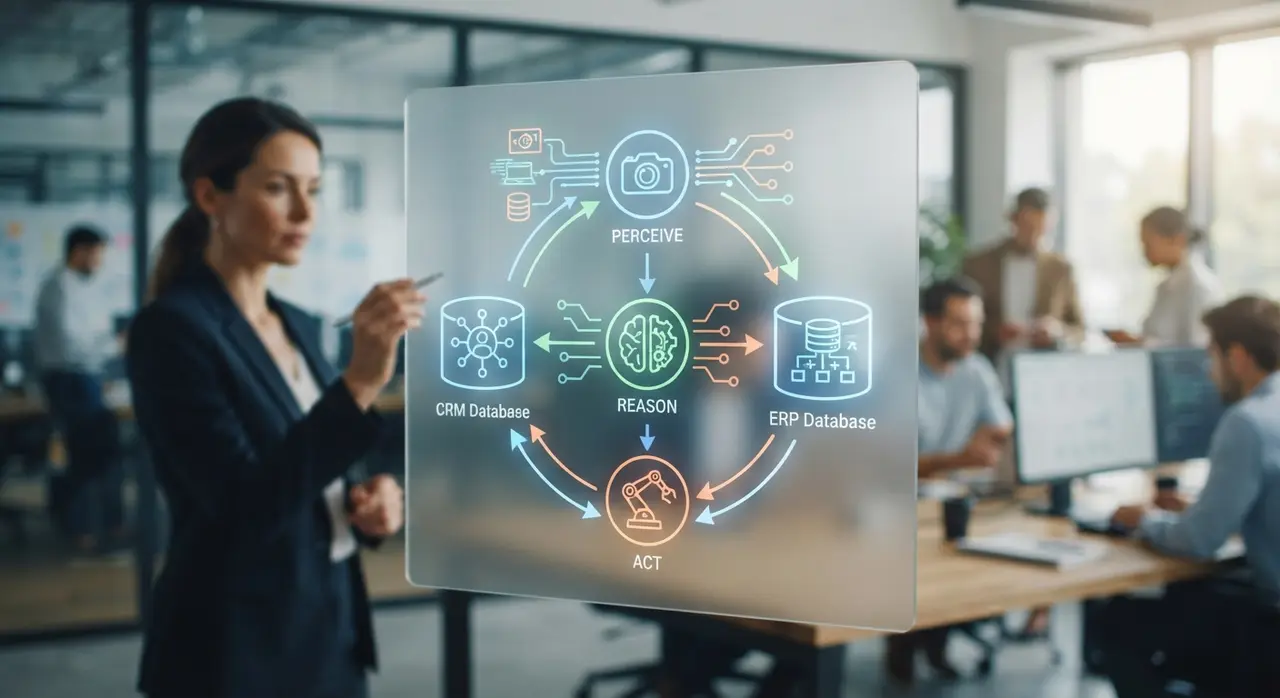
The foundation of any autonomous agent relies on an iterative cognitive cycle known as the Perceive-Reason-Act loop. This continuous loop allows the system to operate effectively in dynamic business environments where parameters change unpredictably.
- Perceive: The agent receives structured or unstructured trigger data from enterprise communication channels, WhatsApp messages, webhooks, or database logs.
- Reason: Using advanced large language models combined with long-term memory, the agent evaluates the objective, identifies missing information, and formulates a step-by-step execution plan.
- Act: The agent calls external integrations—such as reading inventory levels, creating financial credits, or updating CRM pipeline stages.
- Reflect & Correct: The system verifies whether the tool execution yielded the expected state change, adjusting next steps if anomalies occur.
This loop eliminates the need for rigid workflow mapping for every edge case, drastically reducing software maintenance costs while improving response times across multi-unit operations.
Governance, Guardrails, and Human-in-the-Loop Integration
Uncontrolled autonomy presents significant financial, legal, and operational risks to an enterprise. Deploying agentic solutions requires robust governance frameworks and explicit permission boundaries to protect enterprise data and brand integrity.
Effective deployment models implement a hybrid framework where routine actions execute autonomously, while high-stakes decisions trigger a Human-in-the-Loop (HITL) review process. Establishing proper protocols requires a thorough AI automation diagnosis and risk mapping strategy before expanding deployment scale.
Key governance layers include:
- Role-Based Access Control (RBAC): Restricting agent credentials to only necessary database tables and API endpoints.
- Threshold Guardrails: Requiring explicit manager sign-off for actions exceeding defined financial or risk parameters (e.g., refunds over $1,000).
- Audit Logging: Recording every step of the agent's reasoning process and tool usage for complete operational transparency.

Practical Case Study: Scaling Support Without Expanding Infrastructure
A regional logistics and retail provider operating 14 branches across Brazil struggled with customer service delays and repetitive inventory updates across legacy ERPs and WhatsApp channels. Manual re-entry of dispatch confirmation caused frequent operational backlog and high human error rates.
By partnering with Agentes Autônomos, the client introduced autonomous operational agents that integrated directly into their existing WhatsApp and ERP infrastructure without requiring system migration. When a buyer inquired about order modifications or billing discrepancies, the agent dynamically retrieved invoice data, queried stock balances, recalculated delivery timelines, and updated the CRM automatically.
The result was a 70% reduction in response latency, a 45% drop in operational rework, and immediate capacity expansion across customer support teams—all while maintaining full human control over high-value approval steps.
Why Agentic AI Is the Next Stage for Enterprise Growth
Organizations reach a clear ceiling when scaling operations purely through headcount or linear rule-based automation. As process complexity scales, rigid scripts break, leading to fragmented customer experiences, employee burnout, and lost revenue opportunities.
Agentic AI delivers a scalable operational backbone that learns from past interactions, enforces business rules consistently, and adapts dynamically to enterprise growth. By handing off routine execution, multi-unit coordination, and system synchronization to autonomous agents, business leaders can focus human talent where it matters most: strategic innovation and critical relationship management.
To explore how tailored intelligent workflows fit into your current business ecosystem, review our practical enterprise automation solutions.
Frequently asked questions
What is the difference between Generative AI and Agentic AI?
Generative AI focuses primarily on content generation, text summarization, and creative output based on prompt directives. Agentic AI uses generative models as a reasoning engine but extends capability by planning, using external tools via APIs, and independently executing tasks to achieve business outcomes.
Do I need to replace my existing ERP or CRM to implement Agentic AI?
No, agentic systems integrate directly into your existing IT infrastructure using APIs, database connectors, and messaging channels like WhatsApp. They act as an intelligent orchestration layer on top of your current tools, avoiding costly software overhauls.
How do business leaders manage security risks when deploying autonomous agents?
Security and governance are maintained through role-based permission boundaries, API credential encryption, strict transactional thresholds, and Human-in-the-Loop approval triggers for high-risk operations. Every action and reasoning step taken by the agent is captured in complete audit logs.
What types of business departments benefit most from Agentic AI?
Departments handling high-volume operational workflows—such as customer support, sales operations, procurement, finance billing, logistics, and multi-unit resource allocation—see the highest return on investment from agentic automation.