Process Standardization with AI for Multi-Unit Operations
Discover how process standardization with AI enables multi-unit enterprises to ensure control and consistent execution across CRM, ERP, and WhatsApp.
- Process Automation
- Multi-Unit Operations
- AI Governance
- Operational Efficiency
- Process Standardization

Process standardization with AI provides multi-unit enterprises with an orchestration layer that enforces uniform business rules across distributed branches. By linking legacy systems like ERPs, CRMs, and WhatsApp to autonomous AI agents, organizations ensure control and consistent execution without forcing each regional office to replace its current software stack.
As companies expand across regional branches, franchises, or business units, operational variance grows exponentially. Local teams adapt workflows to meet short-term deadlines, central teams lose visibility, and service quality becomes unpredictable. Implementing intelligent agents solves this challenge by embedding automated compliance, structured human-in-the-loop approvals, and real-time process oversight directly into daily operations.
Why Manual Standardization Fails Across Multi-Unit Companies
Manual standardization fails in multi-unit operations because local teams inevitably create unmonitored process variations to resolve immediate execution bottlenecks. Static Standard Operating Procedures (SOPs) stored in PDFs or training manuals are rarely followed consistently under operational pressure.
When each branch executes tasks differently, central management suffers from three core structural issues:
- Operational Drift: Local branches develop unique habits for lead intake, discount approvals, or procurement requests, eroding corporate guidelines.
- Fragmented Visibility: Central executives receive delayed or distorted reports because each branch logs data inconsistently into the local CRM or ERP.
- Escalating Rework: Incomplete customer records and unverified handoffs create frequent internal friction, requiring manual intervention from central leadership.
Relying on periodic audits or manual spot-checks only identifies deviations after damage has occurred. True multi-unit scalability requires continuous automated enforcement at the moment tasks are performed.
How AI Agents Enforce Business Rules Without Replacing Legacy Systems
Intelligent agents act as a governance middleware that sits on top of existing ERPs, CRMs, and communication channels to standardize workflows automatically. Rather than ripping and replacing legacy software, companies connect AI agents to their current infrastructure via standard APIs and webhooks.
This orchestration architecture ensures that every transaction follows corporate logic while catering to authorized regional variations. For example, pricing models can remain governed centrally while allowing regional managers local flexibility within strictly defined ranges.
By leveraging an AI shared services center framework, organizations centralize business rule administration while giving individual units speed and autonomy.
| Operational Dimension | Manual SOPs | Legacy RPA Tools | AI-Agent Orchestration |
|---|---|---|---|
| Rule Flexibility | High (uncontrolled variations) | Rigid (breaks on minor UI changes) | Adaptive (handles context & unstructured data) |
| Cross-Branch Visibility | Delayed / Manual reporting | Siloed by specific database tasks | Real-time consolidated analytics |
| Exception Handling | Depends entirely on humans | Fails and triggers error logs | Human-in-the-loop routing |
| Local Parameterization | Difficult to audit | Requires hardcoded updates | Central control with local parameters |
Core Mechanisms: Checklists, Automated Approvals, and Real-Time Alerts
Automated compliance monitoring continuously verifies operational inputs and instantly triggers corrective workflows before errors reach end clients. AI agents execute three main functions across distributed units:
- Standardized Approval Chains: AI agents validate discount requests, credit limits, or purchase orders against central business rules before passing exceptions to managers on WhatsApp or Teams.
- Automated Operational Checklists: Before a deal or ticket transitions to the next stage in a CRM, the AI agent checks for required documents, correct tags, and SLA adherence.
- Real-Time Variance Alerts: When a unit strays from standardized cycle times or data standards, central governance teams receive immediate notification with actionable diagnosis.
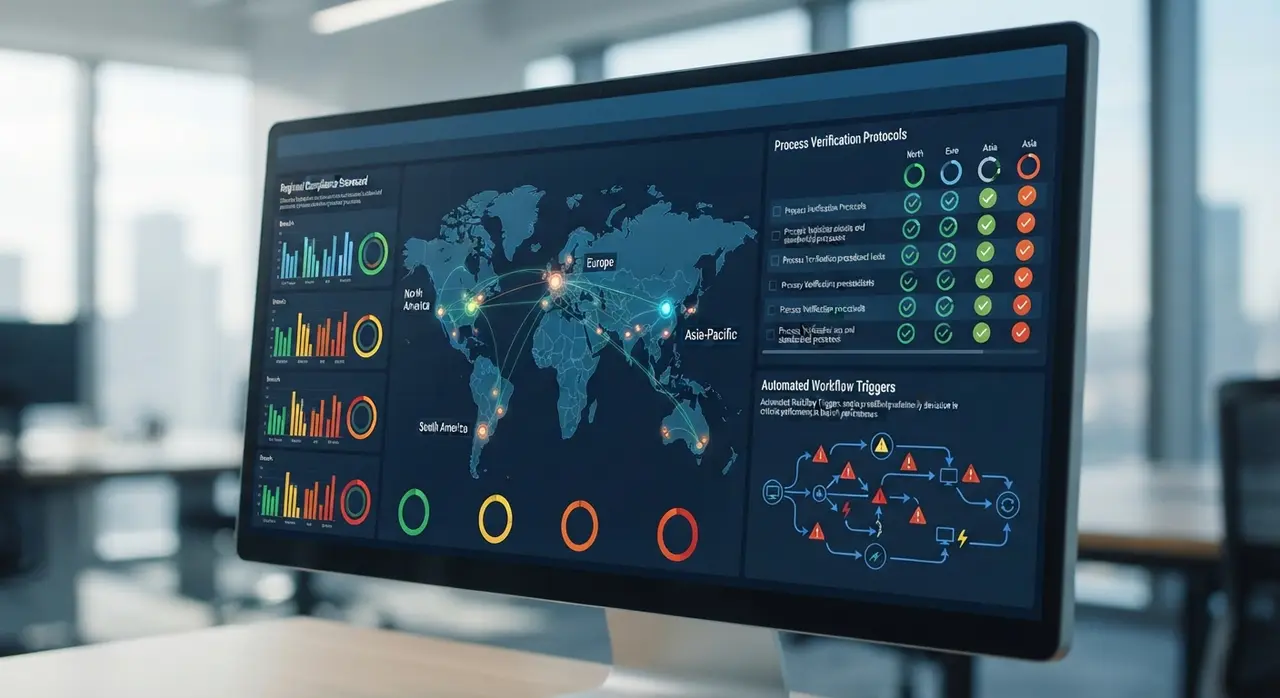
This automated rigor maintains high execution standards across all locations without increasing administrative burden on branch staff.
Multi-Unit Data Governance and Cross-Branch Benchmarking
Multi-unit data governance aggregates normalized transactional metrics across all branches to make operational performance directly comparable. When data collection relies on human entry, regional variations make central metrics unreliable.
AI agents automatically parse, clean, and enrich incoming operational data from WhatsApp chats, ERP entries, and support tickets. This provides headquarters with unbiased data streams for fair cross-branch benchmarking.
Integrating automated CRM reports and indicators allows leadership to identify high-performing locations, uncover systemic bottlenecks, and replicate success factors corporate-wide.
Overcoming Cultural Friction: Making the Standard the Path of Least Resistance
Reducing operational friction makes compliance the default choice for branch staff because AI agents handle repetitive data entry and routing automatically. Resistance to central standardization usually stems from cumbersome software interfaces and slow approval chains.
When AI agents handle form fills, pre-populate customer records, and handle routing instantly over messaging apps, local teams adopt standardized workflows willingly. Compliance becomes simpler than creating manual workarounds.
Mini Case Study: Multi-Branch Logistics and Service Operations
Sector: Multi-unit equipment distributor with 18 regional service branches.
Problem: Branch managers were issuing customer quotes using custom spreadsheets, causing unpredictable margin erosion and inconsistent warranty terms across regions.
Solution: The company deployed Agentes Autônomos to orchestrate lead intake over WhatsApp and link approval rules directly to their central ERP system. AI agents handled initial data validation and enforced standardized pricing formulas while routing special quote exceptions to regional directors in seconds.
Results: Quote preparation time dropped significantly, margin leakage was reduced to zero across all 18 branches, and leadership gained 100% visibility into operational compliance.

Companies planning similar rollouts should perform an initial AI automation diagnosis to map existing bottlenecks and prioritize high-impact workflows.
Conclusion
Achieving consistent execution across multi-unit operations no longer requires rigid micro-management or disruptive system overhauls. By deploying autonomous AI agents as an orchestration layer, corporate leaders establish central governance, empower local teams, and drive predictable business results.
Frequently Asked Questions
How does process standardization with AI work across different systems?
AI agents connect to existing CRMs, ERPs, and communication platforms like WhatsApp via APIs. They monitor operational inputs, enforce validation rules, and update records across all connected databases without requiring software replacements.
Do regional managers lose autonomy when central AI governance is implemented?
No, central teams set explicit rule boundaries while allowing regional managers controlled parameters for local flexibility. Local leaders retain authorization rights for predefined exceptions through automated human-in-the-loop review queues.
How long does it take to deploy AI standardization across multiple branches?
Deployments are typically iterative, starting with a diagnostic pilot in 1 to 2 branches over 3 to 4 weeks. Once core business rules and system integrations are validated, rollout across remaining locations proceeds rapidly.
What happens when an operational transaction falls outside standard rules?
When an exception occurs, the AI agent flags the irregularity and routes it directly to a designated human manager with relevant context. Once approved or corrected by the manager, the AI resumes processing the standardized workflow.